How to Fit Jump Rope Into a Week That Already Includes Lifting
Quick Answer: Jump rope loads the calves and Achilles heavily, so it conflicts most with squat and deadlift days. Put rope work after lifting rather than before, keep it away from the day before heavy lower-body training, and start at 5 to 8 total minutes broken into sets. If calves are sore from lifting, skip the rope rather than working through it — the Achilles is the tissue that accumulates the damage.
You added ten minutes of rope three days a week.
Two weeks later your squats felt heavy and your calves never stopped being sore.
Nothing was wrong with either activity.

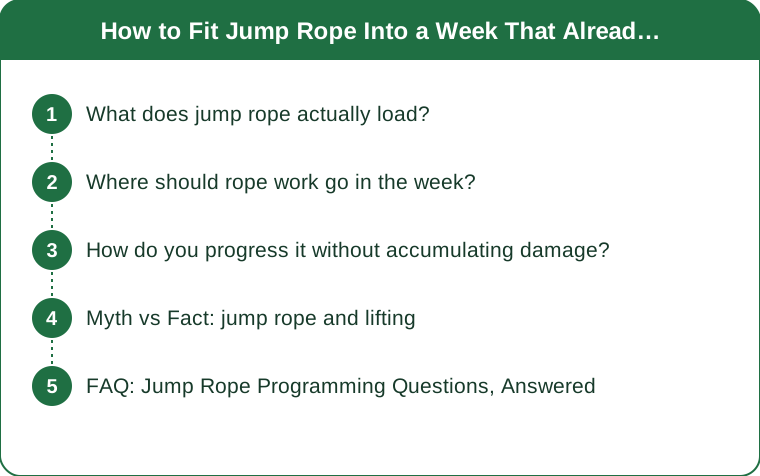
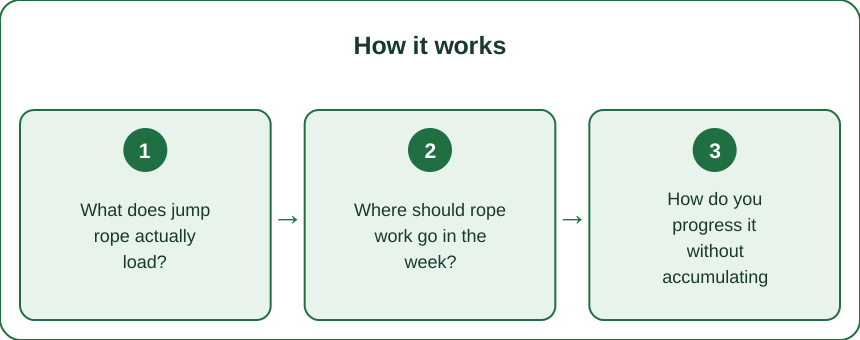
What does jump rope actually load?
More than it looks like from the outside.
The calves and Achilles take the majority of it. Every rebound is a rapid stretch-shortening cycle through the ankle, and a ten-minute session at 120 skips per minute is around 1,200 of them.
The tibialis anterior and the shins work eccentrically to control landing, which is why shin discomfort is the most common early complaint.
The foot’s arch and plantar fascia absorb load repeatedly, and this is a slow-adapting structure.
The cardiovascular demand is high relative to the effort it looks like. Rope work reaches a higher heart rate faster than running at a comparable perceived effort, which is part of what makes it efficient.
What it does not load much: the quads, glutes, and hamstrings. Which is exactly why it seems compatible with leg day and is not — the conflict is at the ankle and the Achilles, not in the big muscles you were thinking about.
Squats and deadlifts also load the calves and Achilles, less obviously but meaningfully. Stack them on consecutive days and the ankle complex gets no recovery window at all.
Where should rope work go in the week?
Ordered by how well each placement works.
Best: after an upper-body session. No lower-body conflict, and you are already warm. This is the placement that causes the fewest problems.
Good: after a lower-body session, on the same day. Counterintuitive, and it works — you concentrate the ankle load onto one day and leave the next day clear. Keep it short, 5 minutes or so, since the tissue is already fatigued.
Acceptable: on a rest day, kept light. A short easy session on an off day is fine, and it does mean the day is no longer fully a rest day. Fine occasionally, problematic as a routine.
Worst: the day before heavy squats or deadlifts. The calves and Achilles will still be recovering, and the ankle contribution to a heavy squat is larger than people assume. This placement is responsible for most of the complaints.
Also worst: before lifting. Pre-fatigued calves change your squat mechanics, and the fatigue costs you more on the bar than the conditioning gains you.
Weekly volume to start: 5 to 8 minutes total, twice a week, broken into sets of 30 to 60 seconds. That is far less than most people start with, and it is the amount the Achilles can absorb while you are also lifting.

How do you progress it without accumulating damage?
By adding sets rather than minutes, and by watching one specific signal.
Progress by adding sets, not by extending sets. Six sets of 45 seconds is more manageable than three sets of 90, because the tissue gets brief recovery and the technique holds up. Technique degrading is when the damage happens.
Add roughly one set per week, which is a slow enough increase for connective tissue.
The signal to watch is morning calf and Achilles stiffness. Stiffness on the first steps out of bed that eases within a few minutes is normal adaptation. Stiffness that takes longer than about ten minutes to ease, or that is getting worse week over week, means the volume is too high.
Achilles pain specifically is worth taking seriously and early. Tendon problems develop slowly, give little warning, and take months to resolve. Reduce volume at the first sign rather than after two more weeks. This is general information, not medical advice — persistent tendon pain deserves a professional opinion.
Surface matters more than most variables. A wood floor or a rubber gym mat is substantially kinder than concrete, and a hard cold surface in an autumn garage is the harshest option available. If the surface is unavoidable, cut the volume.
And keep some calf strength work in the program. Straight-leg and bent-knee calf raises build the capacity that lets the rope work be absorbed, and they are the best insurance available.
Myth vs Fact: jump rope and lifting
Myth: rope work will kill your gains.
Fact: modest amounts of conditioning alongside lifting do not meaningfully impair strength or muscle gain, and the cardiovascular benefits are substantial. The interference effect is real at high volumes of concurrent training and largely irrelevant at 10 to 15 minutes twice a week.
Myth: jump rope is a good warm-up before lifting.
Fact: it is a poor warm-up for lower-body days specifically, because it fatigues the calves before you squat. It is a reasonable warm-up before upper-body work.
Myth: heavier ropes build more strength.
Fact: weighted ropes increase forearm and shoulder demand, not leg strength. They are a different stimulus and they do not change the ankle loading much.
Myth: you should jump higher for a better workout.
Fact: jumping higher is the most common cause of premature fatigue and shin pain. A clearance of about an inch is all that is required, and higher jumps increase landing force for no benefit.
Myth: sore calves mean it is working.
Fact: sore calves mean the calves are loaded, which they will be from lifting too. Persistent soreness across a whole week is a volume signal, not a badge.
FAQ: Jump Rope Programming Questions, Answered
Can I do rope work every day?
Not while also lifting lower body, at least not initially. Two to three sessions a week is a sustainable starting point, and daily rope work is something to build toward over months if at all.
What surface is best if I only have concrete?
A rubber mat or a piece of plywood over the concrete. Even a thin gym mat meaningfully reduces impact, and it is much cheaper than dealing with shin or Achilles problems. Shoes with real cushioning help too.
Does jump rope replace running for conditioning?
It can, for shorter-duration work. The cardiovascular stimulus is comparable and the joint loading pattern is different — more ankle, less knee and hip. Many people use it as a running substitute when weather or time is limiting.
How do I know if it is affecting my lifting?
Watch your working weights over three to four weeks. If loads are stalling and calf soreness is constant, the conditioning is taking more than it is giving. Cut the rope volume in half for two weeks and see what happens.
Should I stop rope work entirely during a heavy strength block?
Reduce rather than eliminate. A short session or two a week maintains the conditioning and the skill without competing much, and dropping it entirely means rebuilding from scratch later. Five minutes twice a week is enough to hold what you have.
TL;DR:
- Rope work loads the calves, Achilles, shins, and arch — not the quads and glutes, which is why the conflict is unexpected.
- Best placement is after an upper-body session; second best is after lower-body work on the same day.
- Never the day before heavy squats or deadlifts, and never before lifting.
- Start at 5 to 8 total minutes twice a week, in sets of 30 to 60 seconds.
- Progress by adding sets, not by extending them, roughly one set per week.
- Morning Achilles stiffness lasting over ten minutes means the volume is too high.
Put the ankle load on days that already have it, and the two activities stop fighting each other.
Keep Reading
This article is for general informational and styling purposes only. Fit, sizing, and product availability may vary.