Why Jump Rope Handles Matter More Than the Cable
Quick Answer: Handle length determines how far the rope’s pivot point sits from your wrist, which changes the effective rope length and the arc it travels. Handle weight determines whether you can feel the rope’s position without looking. Handle diameter determines grip force, and grip force is the main cause of forearm fatigue. A good cable on bad handles is a worse rope than an ordinary cable on good handles - and handles are the part almost nobody evaluates.
You bought a cable. You use handles.

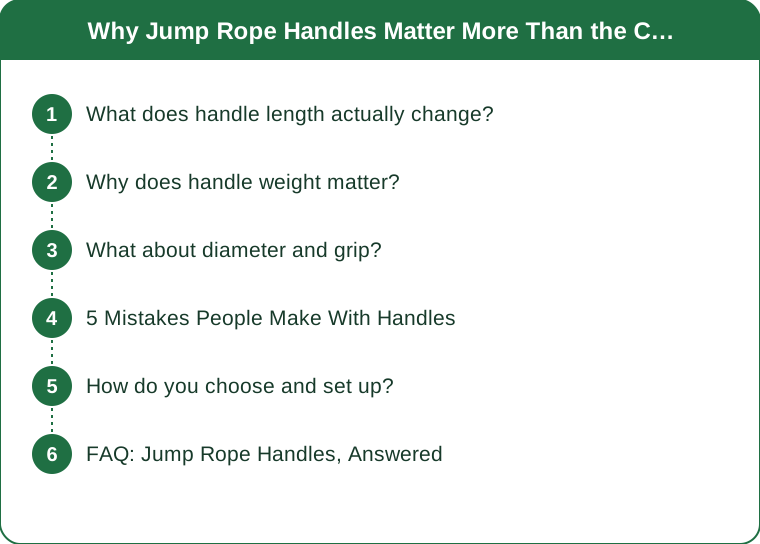
What does handle length actually change?
A longer handle moves the pivot point further from your wrist, which effectively lengthens the rope beyond what the cable measurement says.
That changes the height of the rope’s arc over your head and the clearance under your feet.
Two ropes cut to identical cable length can behave completely differently if the handles differ by an inch each.
Longer handles give more leverage and make the rope easier to turn slowly, which suits beginners and freestyle work.
Shorter handles give faster, tighter turning and suit speed work and double unders.
Which is why re-sizing a rope after switching handle style is necessary, and why the same person can need two different cable lengths for two ropes.
Why does handle weight matter?
Weighted handles give proprioceptive feedback - you can feel where the rope is without seeing it.
That feedback is what lets beginners learn timing far faster than with very light handles.
Very light speed handles give almost no feedback, which is fine once timing is automatic and unhelpful before then.
Handle weight also slows the turn slightly, which is useful for learning and a disadvantage for speed work.
Weighted handles fatigue the shoulders rather than the forearms, a different fatigue pattern that some people prefer.
And handle weight is not the same as a weighted cable - the first changes feel, the second changes training load, and they are frequently confused.
What about diameter and grip?
A handle too thin requires more grip force to control, and grip force is the main driver of forearm fatigue.
A handle too thick prevents the fingers from wrapping, which produces a different kind of insecure grip and the same result.
Most people are better served by a slightly thicker handle than they think, since a relaxed grip is the goal.
Knurled or textured handles allow a lighter grip because they do not need to be squeezed to stay put.
Sweaty hands change everything, which is why grip texture matters more in a session than it does in a shop.
And the grip should be at the base of the fingers, not deep in the palm, which is easier with a handle of appropriate diameter.

5 Mistakes People Make With Handles
Mistake one: buying by cable spec alone. Bearing type and cable coating are what product pages discuss, and neither is what your hands interact with.
Mistake two: gripping the very end of the handle. Hands should sit toward the top, near the cable exit, for control.
Mistake three: choosing speed handles as a beginner. Very light handles remove the feedback that teaches timing.
Mistake four: keeping the same cable length after changing handles. Handle length is part of total rope length, and ignoring it produces a rope that trips constantly.
Mistake five: squeezing. The handle should sit in a relaxed hand with the thumb guiding. Squeezing produces the forearm burn people attribute to conditioning.
And the sixth: ignoring bearing quality entirely. Poor bearings mean the handle has to be turned rather than the cable, which sends the work back up the arm.
How do you choose and set up?
Choose medium-length handles for general use - around five to six inches - unless you have a specific speed or freestyle goal.
Choose some handle weight if you are learning, and light handles only once timing is automatic.
Choose a diameter that lets you hold it with a relaxed hand, tested by holding it for a full minute.
Re-measure the rope after any handle change, standing on the middle of the cable with handles reaching roughly to the lower chest.
Check the bearings by spinning the handle - it should continue turning freely for several seconds.
And hold the handles near the cable exit with thumbs along the handle, which is the position that makes wrist-driven turning possible. This is general information, not medical advice.
FAQ: Jump Rope Handles, Answered
Does handle length change rope length?
Yes. The pivot point sits at the handle, so handle length is part of the total. Re-measure after any handle change.
Should beginners use weighted handles?
Usually yes. The added feedback makes it much easier to learn where the rope is without looking.
Why do my forearms burn?
Grip force, almost always. A relaxed hand on an appropriately thick, textured handle removes most of it.
Where should I hold the handle?
Toward the top, near where the cable exits, with the thumb along the handle rather than wrapped around the end.
Do bearings really matter?
Yes. Poor bearings mean you turn the handle instead of the cable, which moves the work from the wrist up to the shoulder.
How long should handles be?
Around five to six inches for general use. Shorter for speed work, longer for freestyle and slow control. This is general information, not medical advice.
TL;DR:
- Handle length shifts the rope’s pivot point, so it changes effective rope length and arc height - re-measure after any handle change.
- Handle weight provides the feedback that teaches timing; very light speed handles remove it.
- Handle diameter and texture decide grip force, and grip force is what actually burns your forearms.
- Hold near the cable exit with the thumb along the handle, in a relaxed hand.
- Bearings matter because bad ones move the work from the wrist to the shoulder.
Medium length, some weight, comfortable diameter, decent bearings. That covers almost everyone. This is general information, not medical advice.
Keep Reading
This article is for general informational and styling purposes only. Fit, sizing, and product availability may vary.