Why Moving Jump Rope Indoors Changes More Than the Surface Under You
Quick Answer: Indoors changes four things at once: ceiling height forces a lower rope arc, harder floors raise impact per jump, cooler and drier air changes rope speed and grip, and noise limits how long you skip. The most consequential is the floor — concrete under thin flooring produces meaningfully higher impact than grass or tarmac, and calf and shin complaints in autumn almost always trace back to it.
The rope is the same. Everything around it moved.
Here is what each change does.

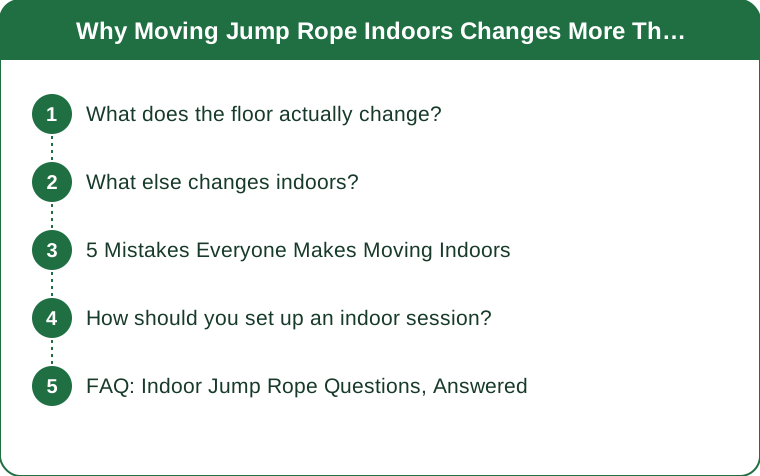
What does the floor actually change?
Impact force per landing rises on a stiffer surface. Concrete, even under laminate or thin rubber, returns far more force than grass or a running track.
Total load is the product of impact and repetitions, and skipping is one of the highest-repetition activities there is. Small increases per jump add up rapidly.
Calves and shins take the majority of it. These are the tissues that report autumn skipping problems, and the surface change is usually the whole explanation.
Adaptation takes weeks, not days. Connective tissue adapts more slowly than muscle, so tolerance for a new surface builds gradually.
And most people increase volume at the same time, because indoor sessions are more convenient. Harder surface plus more repetitions is the specific combination that produces shin complaints.
What else changes indoors?
Ceiling height forces a lower rope arc, which changes wrist mechanics and often raises rope speed unintentionally.
A faster rope means a faster cadence, which means more foot contacts per minute on the harder floor.
Cooler, drier air makes some rope materials stiffer, particularly PVC, which changes the feel and the timing.
Grip changes. Dry hands on cold handles slip differently from sweaty hands on warm ones, which affects consistency more than people expect.
Noise limits duration. Skipping in a flat or a shared building means shorter sessions, which changes the structure of your training whether you planned it or not.
And space limits movement variety. Fewer variations, more repetitions of the same pattern, which is a load-distribution problem.

5 Mistakes Everyone Makes Moving Indoors
Keeping the same volume on a harder surface. The most common error and the direct cause of most autumn shin complaints.
Skipping on thin matting over concrete and assuming it is enough. A thin mat provides grip, not impact absorption. They are different properties.
Letting the rope speed creep up. A lower arc naturally speeds the rope, which raises cadence and contacts without any decision.
Skipping in the same shoes as summer. Cushioning matters far more on a hard indoor surface than on grass.
Ignoring early shin discomfort. Shin pain that appears within two weeks of a surface change is a clear signal, and continuing through it is how a niggle becomes a lay-off.
And a sixth: doing only one variation. Single-foot, alternating and double-unders load differently, and variety distributes the load that a hard floor concentrates.
How should you set up an indoor session?
Reduce volume by a third for the first two weeks. Let tissue adapt to the surface before rebuilding.
Get proper impact absorption underfoot. A thick foam or rubber mat, not a yoga mat, and preferably one designed for impact.
Check your rope length for the lower arc, and slow the rope deliberately rather than letting the space set the speed.
Wear cushioned shoes. Barefoot or minimal skipping on concrete is a large step up in load from the same thing on grass.
Vary the pattern within a session. Alternating feet, single foot, side to side. Variety spreads the load across tissues.
Split sessions into shorter blocks. Three blocks of three minutes distributes load and fits noise constraints better than one long block.
And build back over four weeks, not one. If pain persists or worsens, get it assessed rather than pushing through. This is general information, not medical advice.
FAQ: Indoor Jump Rope Questions, Answered
Why do my shins hurt since moving indoors?
Stiffer floors return more force per landing, and skipping is very high repetition. The surface change is usually the whole explanation.
Is a yoga mat enough padding?
No. Thin mats provide grip rather than impact absorption. You need thicker foam or rubber designed for impact.
Should I skip barefoot indoors?
On concrete, generally not. Cushioned shoes matter considerably more on a hard indoor surface than on grass.
Why does my rope feel faster indoors?
A lower ceiling forces a lower arc, which speeds the rope and raises your cadence without any deliberate change.
How much should I reduce volume?
By about a third for the first two weeks, then rebuild over about four weeks.
When should I get shin pain checked?
If it persists beyond a couple of weeks of reduced load, worsens, or becomes localised and sharp. This is general information, not medical advice.
TL;DR:
- Stiffer indoor floors raise impact per landing, and skipping is extremely high repetition.
- Lower ceilings force a lower arc, which speeds the rope and raises cadence.
- Thin mats give grip, not impact absorption; you need thicker foam or rubber.
- Reduce volume by a third for two weeks and rebuild over four.
- Wear cushioned shoes and vary the pattern within each session.
- Shin pain within two weeks of a surface change is a signal, not something to push through.
The surface is the variable. Everything else follows from it.
Keep Reading
This article is for general informational and styling purposes only. Fit, sizing, and product availability may vary.