How to Size a Jump Rope When the Standard Rule Does Not Fit You
Quick Answer: The standard rule - stand on the middle of the rope and the handles should reach your armpits - assumes average arm length and torso proportions. If you have long arms, a short torso, or you skip with your hands low and wide, that length will be too long. Better method: set the rope so the arc passes about 6 to 10 inches above your head at the top with your hands at your natural position, then shorten in half-inch steps until you stop tripping.
You bought the rope, followed the sizing instructions, and you still catch your feet every eight jumps.
The instructions were written for a body shape, and it may not be yours.

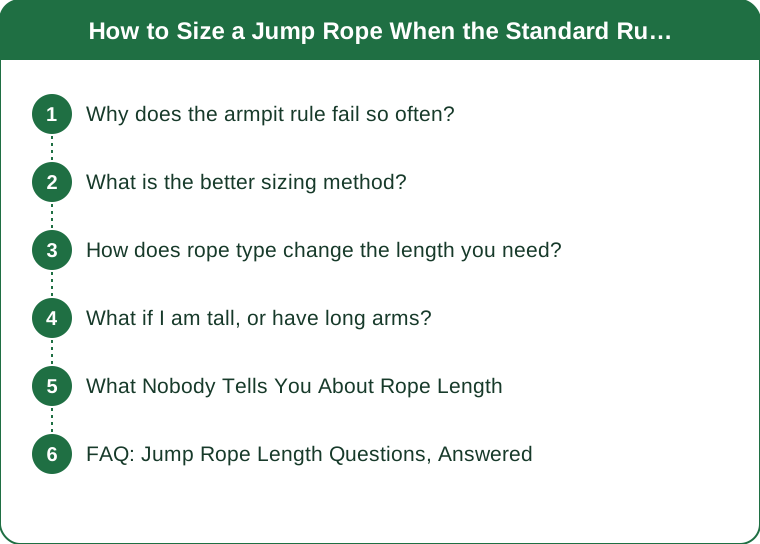
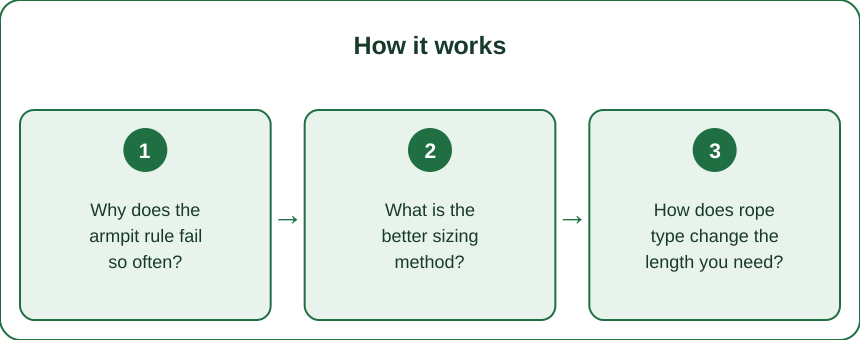
Why does the armpit rule fail so often?
Because it uses one measurement to predict three things: arm length, hand position while skipping, and jumping height.
Arm length varies independently of height. Two people at 5 foot 6 can need different rope lengths depending on where their hands naturally sit.
Hand position is a technique variable, not a fixed one. Skippers who hold their hands low and close to their hips need a shorter rope than those who hold them wide.
The rule also assumes a certain jump height, and efficient skippers barely leave the floor while beginners jump much higher.
It was designed as a safe starting point for beginners, which is exactly what it is - and starting points are meant to be adjusted.
A rope one to two inches too long is the most common setup error and it produces exactly the symptoms people interpret as poor coordination.
What is the better sizing method?
Start with the arc, not the handles. Skip slowly and watch where the top of the rope passes relative to your head - you want roughly 6 to 10 inches of clearance.
Then check your hand position. Hands should sit near your hips, roughly a hand’s width from your body, elbows relaxed. If you are holding your arms out to the side, the rope is likely too long and you are compensating.
Shorten in small increments. Half an inch at a time, testing 30 seconds between changes. Large jumps in length make it impossible to tell what changed.
Test at your actual skipping speed, not slowly, because a rope that works at 60 rpm can be wrong at 140.
Stop when you trip less and the rope makes a consistent sound on the floor - the audio feedback is genuinely useful and underused.
And note that a slightly short rope is more forgiving than a slightly long one for most people, because it forces a tighter, faster arc.
How does rope type change the length you need?
Speed ropes are thin and light and generally want to be shorter, because there is less mass to carry the arc and they move fast.
Beaded ropes are heavier and slower and are more forgiving of a slightly longer setting, which is part of why they are recommended for learning.
Weighted ropes want a slightly longer length than a speed rope for the same person, because the extra mass produces a wider arc.
PVC ropes sit in the middle and are the most common general purpose choice.
Cable ropes are the least forgiving of length error and are also the ones that hurt most when they hit your shins, which is a useful motivator for getting the setting right.
If you own two ropes, they will need different lengths. People frequently set both to the same measurement and wonder why one feels wrong.

What if I am tall, or have long arms?
Check the rope’s maximum length before buying, because many adjustable ropes top out around 10 feet, which is limiting above roughly 6 feet of height.
Long arms mean the standard rule overshoots - your handles reach your armpits at a length that produces far too much clearance overhead.
Start from the arc method rather than the armpit rule, which sidesteps the problem entirely.
Taller skippers often benefit from slightly more clearance, closer to the 10 inch end, because the rope has further to travel and timing errors compound.
Watch for the rope hitting the floor too far in front of you, which indicates excess length and produces the drag that slows the arc.
And if you are shorter than average, most ropes need substantial trimming - a large proportion of adjustable ropes ship at a length suited to nobody in particular and everyone is expected to cut them down.
What Nobody Tells You About Rope Length
Your ideal length changes as you improve. Beginners jump higher and hold their hands wider, both of which need a longer rope. Six weeks in, the same rope feels long - because your technique changed, not because the rope did.
Shoes change it. Skipping in cushioned running shoes versus flat trainers is a difference of up to an inch in effective height, which is enough to matter.
The surface changes it too. A thick gym mat swallows part of the arc and behaves like a shorter rope; smooth concrete gives a cleaner, faster rotation.
Cutting a rope is one-way, so cut long. Trim half an inch at a time and re-test. Everyone who has cut aggressively has bought a second rope.
Rope length affects fatigue, not just tripping. A too-long rope needs bigger arm movement to keep the arc open, which is why some people’s shoulders tire before their calves do.
Cold weather stiffens PVC and cable ropes, which changes how the arc behaves - an outdoor rope in October genuinely feels different from the same rope in July, and it needs a minute to loosen up.
And most people never adjust their rope after the first day. It is a two-minute job with an outsized effect, and it is the first thing to check when skipping suddenly feels worse.
FAQ: Jump Rope Length Questions, Answered
How much clearance should the rope have over my head?
Roughly 6 to 10 inches at the top of the arc with your hands in a natural position. Less than that and timing errors become trips; much more and the rope is slow and tiring.
Is a shorter rope better for speed?
Generally yes - competitive speed skippers use noticeably shorter ropes than the standard rule suggests, because a tighter arc rotates faster. Go shorter gradually as your technique improves.
My rope keeps hitting my shins - is it too long or too short?
Usually too short, or your hands are drifting upward as you fatigue. Check the length first, then watch whether your hands rise over the course of a set.
Should I cut an adjustable rope or leave the excess coiled?
Coiled excess at the handle adds weight and changes the balance, so cut it once you are confident in the length. Test for a couple of weeks first.
Do I need a different length for double unders?
Many people prefer slightly shorter for double unders because the faster arc benefits from less rope. Try half an inch shorter and see.
Does rope length matter more than technique?
No, but a badly sized rope prevents good technique from developing, which is why it is worth fixing first. This is general information, not medical advice.
TL;DR:
- The armpit rule assumes average arm length and hand position, and fails for a lot of people.
- Set length by the arc instead: 6 to 10 inches of clearance above your head at natural hand position.
- Adjust in half-inch steps and test for 30 seconds between changes.
- Speed and cable ropes want shorter; weighted and beaded ropes want slightly longer.
- Shoes, surface and improving technique all change your ideal length.
- Cut long, trim gradually, and re-check whenever skipping suddenly feels harder.
Most skipping frustration is a setup problem wearing a coordination costume.
Keep Reading
This article is for general informational and styling purposes only. Fit, sizing, and product availability may vary.