Jump Rope for Cardio Endurance: Build a Serious Engine
Quick Answer: To build jump rope endurance, train two things separately: continuous steady rounds (start at 1–3 minutes and extend weekly) for your aerobic base, and intervals (30s hard / 30s easy) for conditioning. The reason most people gas out in 90 seconds isn’t fitness — it’s technique. Jump about 1 inch high, turn the rope with your wrists, and breathe on a rhythm. Efficiency buys you more minutes than effort does.
Ninety seconds in, your calves are screaming and you’re breathing like you sprinted. You put the rope down and conclude you’re out of shape.
You’re probably not. You’re jumping six inches high, swinging from your shoulders, and holding your breath — three habits that would exhaust an Olympian.

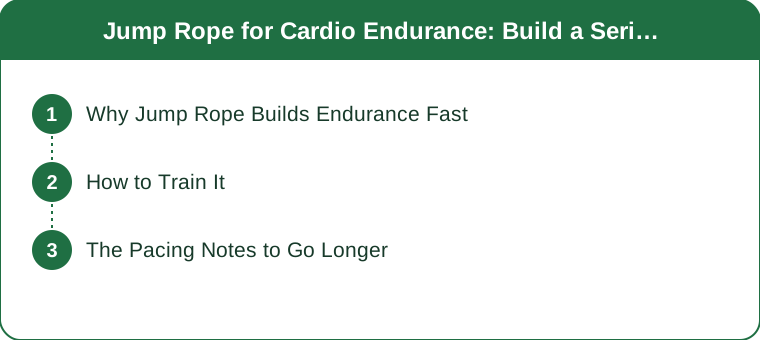
Why does jump rope build cardio endurance so fast?
It gets your heart rate up in under a minute. There’s no ramp-up, no drive to a trailhead. Ten minutes of rope is a real cardio session, which is why it survives in every boxing gym on earth.
It’s a full-body rhythm, not just legs. Calves, ankles, shoulders and core all work while your brain runs a timing task. You’re building coordination and conditioning at once, and coordination is what makes the conditioning accessible.
It scales infinitely by pace. The same rope does an easy aerobic round and a brutal interval. You change the workout by changing tempo, not equipment.
It goes anywhere. A rope weighs about 150 grams and works in a driveway, garage or hotel parking lot — which matters more than any physiological argument, because the sessions you actually do are the ones that build an engine.
And it carries over. Rope conditioning shows up in running, court sports and lifting — better foot speed, better ankle stiffness, better rhythm under fatigue.

How do you train jump rope endurance?
Build the rhythm first, then build time, then add intensity — in that order.
Weeks 1–2: own the basic bounce. Get to where you can do 60 unbroken jumps without thinking. Trips at this stage are a timing problem, not a fitness problem.
Weeks 2–4: build continuous time. Add roughly 30 seconds a week to your longest unbroken round. Going from 1 minute to 5 minutes over a month is a normal, unremarkable progression.
Then run two session types each week:
- Interval day: 30 seconds jumping / 30 seconds easy, 10 rounds. As it gets easier, move to 40/20, then 60/30. This is your conditioning stimulus.
- Steady day: 3 rounds of 3–5 minutes at a pace you could hold while speaking short sentences, 1 minute rest between. This is your aerobic base, and it’s the part most people skip.
Mix in footwork variations — boxer step, alternating feet, side-to-side — not for style, but because they redistribute the work and let you stay on the rope longer.
Set up properly: an adjustable rope sized so the handles reach your armpits when you stand on the middle, on a forgiving surface (rubber tile, wood, packed dirt), in supportive sneakers. Concrete in flat shoes is how calves get angry.
Three sessions a week with rest between beats five sessions you abandon by week two.
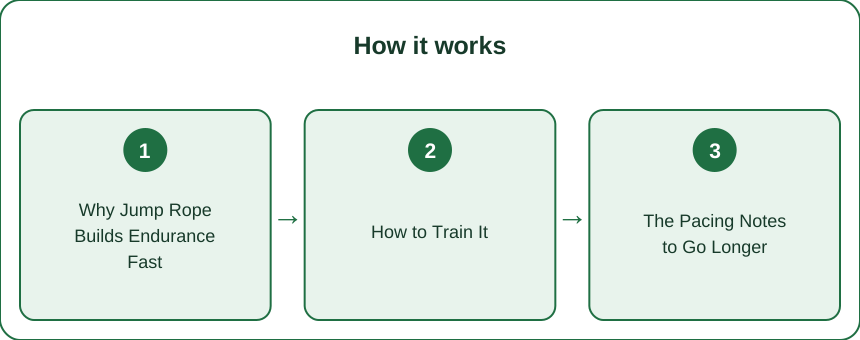
How do you jump longer without gassing out?
Six pacing fixes, roughly in order of how much time they buy you:
- Jump low. One inch of clearance is all the rope needs. Every extra inch is energy spent on nothing.
- Turn from the wrists. Elbows stay near your ribs. Big arm swings are the fastest route to a burning upper back at minute two.
- Stay relaxed. A frantic bounce burns roughly double a smooth one at the same rope speed. Loose shoulders, soft knees, quiet feet.
- Breathe on a rhythm. Match your breath to a fixed count of jumps and hold it there. Breath-holding is the hidden reason people feel “unfit” 60 seconds in.
- Pace the intervals. Your first work bout should feel like you’re leaving something in the tank. If round 1 is all-out, round 6 doesn’t happen.
- Build, don’t blast. Endurance responds to accumulated minutes, not to heroic single sessions — and rest days are when the adaptation actually lands.
Myth vs Fact
Myth: You need to jump fast to get a cardio benefit. Fact: A relaxed 120–140 turns per minute held for five minutes builds more base than 30 frantic seconds. Speed is a variable, not a requirement.
Myth: Jump rope wrecks your knees. Fact: Done low and soft on a forgiving surface, rope is a lower-impact landing than running for most people, because the contact is small, springy and repeated through the ankle. High jumping on concrete is the version that hurts.
Myth: Sore calves mean you’re doing it right. Fact: Sore calves mean you’re new — and they settle within about two weeks as tendons adapt. Persistent calf or shin pain means jump lower, change surface, or take a day off.
Myth: Heavier ropes build more endurance. Fact: Weighted ropes build upper-body fatigue faster, which usually shortens your rounds. For endurance, a light adjustable speed rope wins.
Mini FAQ
How long should a jump rope cardio routine be?
Ten to twenty minutes of actual rope time is a complete session for most people. A common structure is 3 minutes easy, then 10 intervals of 30/30, then 3 minutes easy — roughly 16 minutes and a thoroughly convinced heart rate.
How many days a week should I jump rope for endurance?
Three non-consecutive days is the sweet spot for beginners; four to five is reasonable once you’ve been consistent for a couple of months. Your calves and Achilles, not your lungs, set this ceiling early on.
Is jump roping better cardio than running?
It’s more time-efficient and more portable, and it trains coordination and ankle stiffness that running doesn’t. Running still builds more specific endurance for running. The best answer for most people is both — rope on days when time or weather rules out a run.
TL;DR:
- Master a steady bounce before chasing intensity.
- Extend your longest unbroken round by ~30 seconds a week.
- Run one interval day (30/30 → 40/20) and one steady day (3×3–5 min) per week.
- Jump 1 inch, turn from the wrists, stay relaxed, breathe on a count.
- Adjustable rope sized to your armpits, forgiving surface, supportive shoes.
- Three sessions a week, with rest days doing the adapting.
A serious engine, built from a $12 rope and a patch of ground.
Keep Reading
This article is for general informational and styling purposes only. Fit, sizing, and product availability may vary.