How Much Ceiling Height Do You Actually Need to Jump Rope Indoors?
Quick Answer: A standard 8-foot ceiling is enough for most people to jump rope safely, since a proper jump only clears the ground by 1-2 inches. The real risk isn’t ceiling height for most rooms — it’s rope length and swing arc catching a fan or light fixture.
You want to squeeze in a cardio session without leaving the apartment, but that ceiling fan is making you nervous. The good news: unless your ceiling is genuinely low, the fan isn’t actually your biggest obstacle.

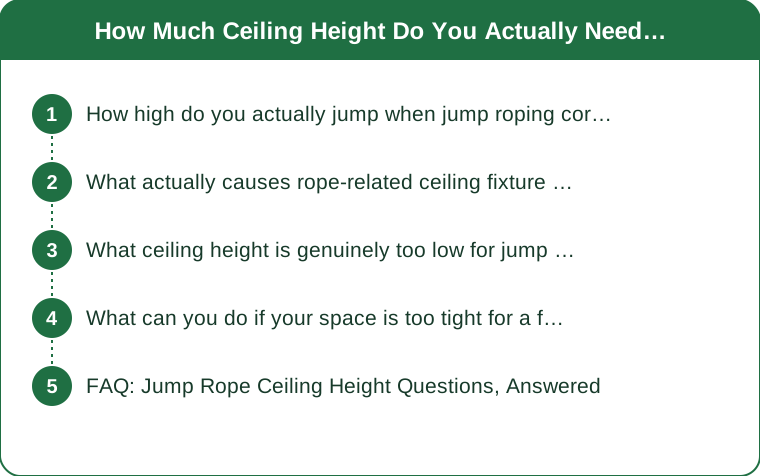
How high do you actually jump when jump roping correctly?
A proper jump rope hop clears the ground by about 1 to 2 inches — just enough for the rope to pass under your feet. Beginners often jump much higher out of nerves or poor timing, which is actually a technique problem worth fixing regardless of ceiling height, since a lower, quicker jump is more efficient and less jarring on your joints.
Most standard interior ceilings (8 feet, sometimes higher) leave more than enough clearance above a correctly executed jump — the head-height danger zone people picture rarely applies. If you’re new to jump rope and unsure whether your jumps are creeping too high, try a few reps in front of a mirror or filming yourself from the side — most people are surprised by how modest a proper hop actually looks compared to how it feels in the moment.
What actually causes rope-related ceiling fixture accidents?
It’s almost never the jump height — it’s the swing arc of the rope itself, especially during faster spins or when a beginner’s wrist technique sends the rope handle up higher than intended. A rope swung with big, sloppy arm circles instead of tight wrist rotations travels much closer to fixtures above.
Keeping your rotations at the wrist, not the shoulder, keeps the rope’s highest point well below head height even in a room with a lower ceiling. A simple cue that helps: imagine your elbows are pinned lightly to your sides, and let only your wrists and forearms do the circling motion — this alone fixes most of the oversized swing arc that causes near-misses with fixtures overhead.

What ceiling height is genuinely too low for jump rope?
Anything under roughly 7 feet starts to feel risky, especially for taller people or anyone still learning wrist-based rotation. In these spaces, the margin for error during a bad rep — a rope that flies up unexpectedly — shrinks fast.
If your available space is a converted basement or a room with exposed low beams, it’s worth measuring before you start rather than finding out mid-session. A quick tape-measure check from floor to the lowest hanging obstacle takes less time than the first round of the workout itself, and it settles the question for good instead of guessing every time you set up.
What can you do if your space is too tight for a full jump rope session?
Try a weighted ropeless jump rope — handles with weighted cords that mimic the motion without a rope swinging overhead — or shift the workout to jumping jacks and high-knee drills that deliver similar cardio without any overhead arc at all. Both options keep the same heart-rate benefit without the ceiling concern.
If you do have adequate height but a tight fixture nearby (a hanging light, not a flush-mount), just reposition a few feet to the side — most rooms have at least one clear jumping zone. Outdoor spaces, even a small patio or driveway, sidestep the whole issue entirely if weather allows, and are worth considering as your default rather than the backup plan.
FAQ: Jump Rope Ceiling Height Questions, Answered
Is an 8-foot ceiling enough to jump rope safely?
Yes, for the vast majority of people — a correct jump only clears 1-2 inches off the ground, leaving plenty of room even with a ceiling fan or light fixture present.
Do taller people need more ceiling clearance?
Somewhat, mainly because taller jumpers have a longer rope arc, but the difference is a few inches, not feet — technique matters more than height in nearly every case.
What’s a safe alternative if my ceiling is too low?
A ropeless weighted jump rope trainer replicates the wrist motion and cardio benefit without any rope swinging overhead, making it the closest substitute for tight spaces.
Should I turn off a ceiling fan before jumping rope just to be safe?
It’s a reasonable extra precaution in a smaller or lower room, even if your technique is solid — there’s no real downside to removing one more variable while you’re still building consistent form.
TL;DR:
- A standard 8-foot ceiling is plenty for correct jump rope technique
- The real risk is a sloppy, wide swing arc, not your actual jump height
- Under 7 feet starts getting genuinely risky, especially for taller jumpers
- Ropeless weighted trainers are a solid substitute in low-ceiling spaces
Measure your space once, fix your wrist rotation, and that nervous glance at the ceiling fan can finally relax.
Keep Reading
This article is for general informational and styling purposes only. Fit, sizing, and product availability may vary.