Why Jump Rope Shin Splints Usually Come From Landing Habits, Not the Rope Itself
Quick Answer: Jump rope shin splints usually come from jumping too high and landing flat-footed, not from the rope itself. Aim to clear the rope by about an inch and land quietly on the balls of your feet with soft knees. Practice the landing without a rope first, keep early sessions to 5 minutes, and increase total volume by roughly 10% a week.
You took up jump rope. Two weeks later your shins ache along the inside edge of the bone, and the obvious suspect is the rope.
The rope is innocent. What’s hurting you is happening a foot below it, about 120 times a minute.

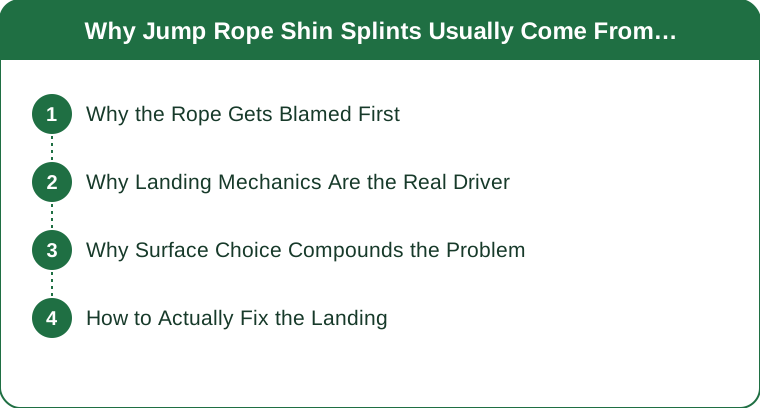
Why Does Jump Rope Cause Shin Splints?
Not because it’s high-impact by nature — because most beginners land badly, at high volume, for the first time in years.
What people call shin splints is usually medial tibial stress syndrome: pain along the inner edge of the tibia, caused by repetitive stress on the bone and the surrounding muscle attachments. The word “repetitive” is doing the heavy lifting there. It’s a cumulative-load injury, not an acute one.
Two beginner habits multiply that load:
Jumping too high. New jumpers routinely clear 6–8 inches when the rope needs about one inch. Every additional inch of height means more downward velocity at landing and a higher peak force to absorb. It’s the single most expensive habit in the sport.
Landing flat-footed. A flat landing bypasses the ankle’s shock-absorbing range entirely and transmits force straight up the tibia. It’s also loud — the audible slap is a reliable diagnostic.
And the volume adds up quickly. At 120 skips a minute, a 10-minute session is 1,200 landings. A small increase in force per landing becomes a very large increase in cumulative load across a week.
Why Does the Rope Get Blamed?
Because the pain appeared right when the rope did, and that’s a compelling coincidence.
If you came from walking, cycling, or the elliptical, jump rope is likely the highest-impact thing your legs have done in a long time. Attributing new pain to the new activity is reasonable inference — it’s just not specific enough to be useful. The activity isn’t the variable you can change. The landing is.
There’s a related misattribution worth naming: people often blame their shoes. Cushioned cross-trainers do help on hard surfaces, and minimalist shoes are a poor choice for a beginner’s jump rope volume. But a good shoe under a flat-footed landing at 8 inches of height is still a flat-footed landing at 8 inches of height.

Does the Surface Matter Too?
Yes, considerably — it’s the second half of the shock-absorption system.
Your legs absorb impact by extending the deceleration time; a surface with give does the same thing by deforming. Concrete deforms essentially not at all, so it returns nearly all the force straight back up.
The practical consequence: the exact same landing habit that feels fine on a sprung gym floor produces real shin pain within two weeks on a driveway. Same person, same technique, different surface.
Best to worst: sprung wood floor → rubber mat (1/2 inch or thicker) → short grass or packed dirt → rubberized track → thin carpet over subfloor. Avoid concrete, asphalt, and tile.
If concrete is your only option, use a proper mat, halve your volume, and build back up slowly.
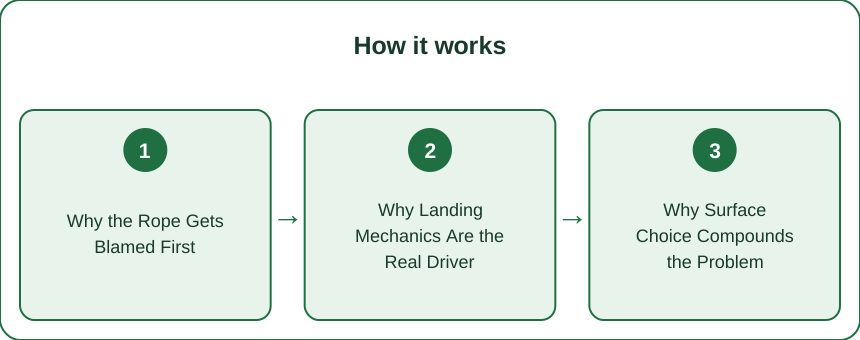
How Do You Fix Your Jump Rope Landing?
Four steps, in order. Do the first one before you pick the rope back up.
1. Practice the landing with no rope at all. Small hops in place, clearing the floor by an inch, landing on the balls of the feet with a soft knee. 30 seconds, 3 times. The goal is silence — if you can hear yourself, you’re still landing flat or jumping high.
2. Add the rope, keep the height. Once quiet hopping is automatic, bring the rope in. The rope needs about an inch of clearance, and if you’re using more you’re doing extra work for no benefit.
3. Check the rope length. A rope that’s too long forces you to jump higher to clear it. Standing on the middle of the rope, the handles should reach roughly to your armpits. A rope that’s too long is one of the most common hidden causes of over-jumping.
4. Ramp volume slowly. Start at 5 minutes total, split into 30–60 second intervals, three times a week. Increase total weekly volume by about 10%. Going from zero to 15 continuous minutes in a week is how nearly everyone finds their tibia’s limit.
Supporting work that helps: calf raises and heel walks build the lower-leg muscles that absorb landing force, and ankle mobility work gives you the range the ball-of-foot landing requires.
What Nobody Tells You About the Quiet Test
The single most useful feedback tool costs nothing: record 20 seconds of audio on your phone while you jump.
You cannot reliably feel the difference between a good landing and a mediocre one — the whole system is designed to make impact feel normal. But you can absolutely hear it. A well-executed session sounds like the rope hitting the floor and almost nothing else. A problem session sounds like a rhythmic slap.
Beginners who record themselves once tend to fix in a day what they’d otherwise carry for months.
FAQ
How long do jump rope shin splints take to heal?
Mild cases typically improve within 1–2 weeks of reduced load plus rest, ice, and gentle calf work. If pain persists beyond 2–3 weeks despite backing off, or is sharply localized to one point on the bone rather than diffuse along it, see a healthcare professional — stress fractures present similarly and need a different approach.
Can I keep jumping rope with shin splints?
Not at the volume that caused them. Reduce total time substantially, switch to a softer surface, fix the landing, and substitute low-impact cardio (cycling, swimming) while the shins settle. Pushing through is how a manageable overuse issue becomes a stress fracture.
How high should you jump when jumping rope?
About one inch — just enough for the rope to pass. If you’re clearing more, check your rope length first (handles should reach roughly to your armpits when you stand on the rope’s midpoint), since an overlong rope forces the extra height whether you intend it or not.
General fitness information, not medical advice. Persistent shin pain, point tenderness on the bone, or pain that worsens during activity warrants assessment by a healthcare professional.
TL;DR:
- Shin splints from jump rope come from jumping too high and landing flat, not from the rope
- Clear the rope by about an inch and land quietly on the balls of your feet with soft knees
- A 10-minute session is ~1,200 landings — small per-landing errors compound fast
- Surface is the other half of the system: rubber mat or sprung wood, never concrete or tile
- Practice the landing with no rope first, check rope length, and add ~10% volume per week
Keep Reading
This article is for general informational and styling purposes only. Fit, sizing, and product availability may vary.