Beyond the Bounce: Your First Jump Rope Tricks
Quick Answer: Learn jump rope tricks in this order: boxer step (shift weight foot to foot — it roughly halves the effort and unlocks long sessions), side swing (both handles to one side for a rhythm-keeping rest), then the criss-cross (arms crossing mid-swing, jumping through the loop). Practise one trick for 3 minutes at the end of a session, when you’re slightly tired — that’s when new skills stick. Expect around 20 failed criss-crosses per clean one at first.
The basic bounce got you fit. Tricks are what keep you coming back.
There’s a specific moment — usually somewhere in week three — where the rope stops being cardio you’re enduring and becomes a skill you’re chasing. Twenty minutes disappear. You have a whip mark on your forearm and you’re delighted about it.


Trick 1: The boxer step (learn this first)
Instead of hopping on both feet, you shift your weight foot to foot — like jogging in place, but soft and small. One rope turn per weight shift.
This is the highest-value trick in the entire sport, and it’s not close. It cuts the perceived effort roughly in half, which is why boxers skip for round after round on this step alone. Two-foot bouncing is genuinely tiring after two minutes; the boxer step lets ten minutes feel easy.
How to learn it:
- Drop the rope. Shift weight foot to foot in place for 30 seconds — barely lifting either foot.
- Add the rope at a slow, steady turn speed.
- Count 1-2-1-2 in your head to keep the shift even.
Common error: lifting the knees. Keep it tiny — this is a weight shift, not a march. If you’re breathing hard within a minute, you’re bouncing too high.
Trick 2: The side swing (the rest that looks like skill)
Bring both handles together to one side of your body and let the rope swing beside you in a full circle, then open your arms and jump back in.
Functionally it’s a rest that keeps your rhythm — your lungs regroup for a couple of seconds while the rope keeps turning and you never break tempo. That’s genuinely useful in a long session.
Structurally it’s the foundation of every freestyle combination you’ll ever envy: side swing → jump, side swing → cross, side swing → double under. Learn the transition and the whole freestyle world opens up.
How to learn it:
- Practise the swing alone: handles together, rope circling at your left side, then your right, no jumping.
- Add one jump between swings: swing left, open, jump once, swing right.
- Then chain it: two swings, four jumps, two swings.
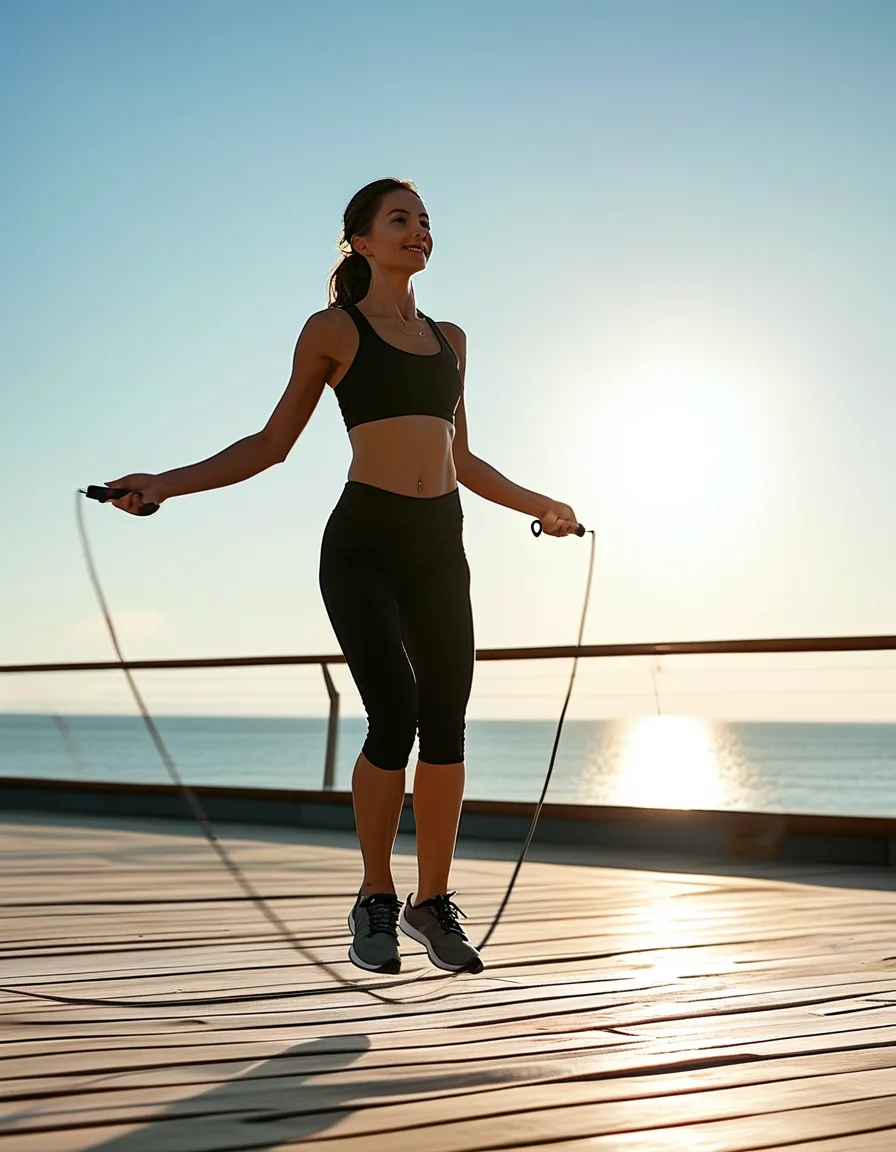
Trick 3: The criss-cross campaign
The classic. Arms cross in front of you mid-swing and you jump through the loop your crossed arms create.
This one has tuition, and the tuition is whip marks. Budget for roughly twenty failures per clean rep in the first week, and consider long sleeves for a session or two.
How to learn it:
- Cross wide and low. This is the whole secret. Timid, narrow crosses collapse the loop and you jump straight into the rope. Cross so your hands end up well past your hips, arms down around waist height.
- Commit fully. Half-crossing is worse than not crossing — the rope needs a real opening to pass through.
- Alternate: normal jump, cross, normal jump, cross. Don’t try consecutive crosses until single ones are reliable.
- Uncross wide too. Most people nail the cross and then trip on the way back out.
One clean criss-cross permanently converts a person who skips into a person with a hobby. It’s a strange and reliable effect.

How should you structure trick practice?
Trick work slots into your cardio sessions rather than replacing them.
The structure: run your intervals as programmed, then finish with a 3-minute “lab” dedicated to your current trick.
The order matters more than it sounds. Fresh-legged trick practice tends not to stick; slightly-tired practice does, because you’re forced into efficient, relaxed mechanics instead of muscling through. It’s also the right place emotionally — you’ve already banked the workout, so twenty failures cost you nothing.
One trick at a time. Work the boxer step until it’s automatic before touching the side swing. Rotating between three half-learned tricks is how people stay stuck for months.
Film your attempts. A ten-second phone clip shows you instantly whether your cross is wide enough, and the progress reel from week one to week six is the best motivator in the sport.
5 Mistakes Everyone Makes Learning Rope Tricks
- Jumping higher to buy time. It doesn’t. Higher jumps make timing harder and burn energy you need for the attempts.
- Crossing narrow. The single reason criss-crosses fail. Wide and low, every time.
- Practising fresh. Save the lab for the end of the session when your mechanics have relaxed.
- Chasing double unders before the basics are automatic. Doubles need a controlled bounce and fast wrists — both of which the boxer step builds first.
- Blaming yourself instead of the rope. The third mistake trips up plenty of people, but this last one wastes weeks: a kinked, badly sized, or too-light rope makes tricks nearly impossible. Handles to your armpits, adjustable, ball bearings.
Mini FAQ
How long does it take to learn the boxer step?
Most people have it inside one or two sessions — it’s far easier than it looks, because it’s closer to natural jogging rhythm than two-foot bouncing is. Getting it smooth enough to hold for five minutes takes about a week of regular practice.
What’s the easiest jump rope trick for beginners?
The boxer step, comfortably. It’s the least technically demanding, delivers an immediate payoff in endurance, and builds the relaxed rhythm every other trick depends on. The side swing is a close second and takes most people a single session.
Do I need a special rope for tricks?
You need a decent adjustable rope — ball bearings, handles reaching your armpits when you stand on the middle. A beaded rope is actually excellent for learning crosses because you can hear the rhythm and it keeps its shape mid-air. Ultralight speed ropes are the hardest to learn tricks on despite being the ones that look fastest.
TL;DR:
- Order: boxer step → side swing → criss-cross. One at a time.
- Boxer step halves the effort and unlocks long sessions.
- Side swing is a rest that keeps rhythm — and the base of all freestyle combos.
- Criss-cross: cross wide and low, commit fully, alternate with normal jumps.
- Practise in a 3-minute lab at the end of a session, slightly tired.
- Film attempts; expect ~20 fails per clean criss-cross early on.
The cardio was the cover story. The tricks are the reason you’ll still be skipping in a year.
Keep Reading
This article is for general informational and styling purposes only. Fit, sizing, and product availability may vary.