Why Jumping Rope on the Balls of Your Feet Only Prevents Shin Splints on Certain Surfaces
Quick Answer: Landing on the balls of your feet reduces jump rope impact, but it was never meant to absorb all of it — a surface with give does the other half. Concrete has essentially none, so it pushes the full load back into your shins and knees regardless of technique. Jump on sprung wood, a rubber mat (at least 1/2 inch), or short grass instead.
You fixed your form. Low jumps, soft knees, landing on the balls of your feet, quiet as anything.
Your shins still hurt. Because you’re doing it on the garage floor, and the garage floor isn’t holding up its end of the deal.
How Does Landing Technique Actually Reduce Impact?
By spreading the collision over more time — and by sharing it with whatever you’re standing on.
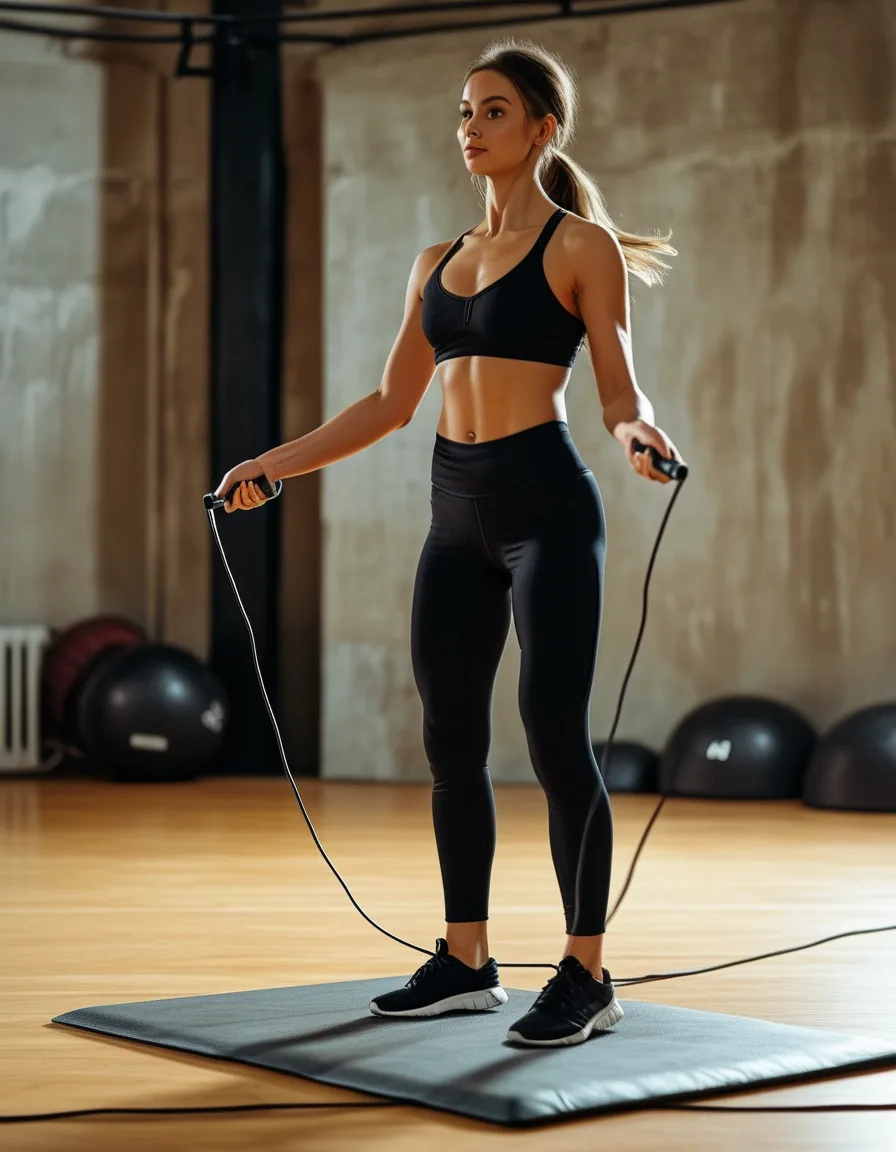
When you land on the balls of your feet with bent knees, your ankle, knee, and hip act as a spring system that extends the deceleration period. Force is roughly change in momentum divided by time, so stretching a landing from an abrupt slap into a soft controlled absorption meaningfully lowers the peak force.
The surface does the same thing by a different mechanism. A sprung wood floor, a rubber mat, or turf deforms on contact, adding milliseconds to the deceleration and dissipating energy as material deformation instead of routing it into your tibia.
So there are two shock absorbers in the system: your legs, and the ground. Good technique optimizes one of them. It has no influence at all over the other.

Why Doesn’t Good Form Protect You on Concrete?
Because concrete’s deformation is functionally zero, and there’s nothing your legs can do about that.
Concrete is one of the stiffest surfaces you’ll ever train on. It doesn’t compress meaningfully under a 140-pound person landing at 2–3 times body weight. It returns essentially all of that energy straight back up the kinetic chain.
Meanwhile, jump rope is high-volume by nature. A modest session at 120 skips per minute for 10 minutes is 1,200 landings. Even a small per-landing increase in peak force multiplies into a substantial difference in cumulative load across a session — and cumulative load is exactly what drives medial tibial stress syndrome, better known as shin splints.
This is why the same person, with the same technique, can jump comfortably for months at a gym and develop shin pain within two weeks of moving the sessions to a driveway. Nothing about them changed. The surface did.
What’s the Best Surface for Jumping Rope?
Ranked from best to worst, with the practical notes that matter:
1. Sprung wood floor — a basketball or dance floor is close to ideal. Built to deform and return energy, and hard enough that the rope turns cleanly.
2. Rubber gym flooring or a dedicated jump rope mat — the realistic best option for most people. Look for at least 1/2 inch (12mm) thickness; thinner mats over concrete provide very little. A 4×6 ft mat is enough for most jumping.
3. Short grass or packed dirt — good shock absorption, and free. The tradeoffs are an uneven surface, a rope that snags and wears, and the ankle risk of hidden dips.
4. Rubberized track or turf — good give, easy on ropes, usually accessible.
5. Thin carpet over subfloor — surprisingly acceptable, though carpet destroys cheap ropes.
Avoid: concrete, asphalt, and tile. Tile deserves a special mention because it’s the worst of both worlds — no give, plus it’s slippery and it cracks.
If concrete is genuinely your only option, three mitigations help: use a mat, cut session volume in half and build slowly, and wear cross-training shoes with cushioning rather than minimalist or flat shoes. And keep sessions to 5-minute blocks with rest, rather than continuous 15-minute efforts.
5 Things People Get Wrong About Jump Rope Impact
- Believing form alone is enough. Form is one of two shock absorbers. It can’t cover for a surface with no give.
- Jumping too high. Most beginners clear 6+ inches when 1–2 is all you need. Every extra inch of height is extra force on landing.
- Landing on the heels or flat-footed. The loud slap is diagnostic — quiet jumping is low-impact jumping.
- Using a thin mat over concrete. A 3mm yoga mat under a 150 lb person on concrete is a comfort item, not shock absorption.
- Ramping volume too fast. Tibial stress builds cumulatively, so going from 0 to 15 minutes daily in a week is a reliable way to find your shin’s limit. Add about 10% per week.
FAQ
Can I jump rope on concrete if I wear cushioned shoes?
Cushioned cross-training shoes help and are much better than flat or minimalist shoes on hard surfaces, but they don’t substitute for a mat — shoe midsoles compress a few millimeters, while a proper mat adds considerably more deformation. Use both if concrete is unavoidable, and keep volume conservative.
How do I know if my landings are too hard?
Listen. A correctly executed jump rope landing is nearly silent; a loud repetitive slap means you’re landing flat or from too high. Recording 20 seconds of audio on your phone is a genuinely useful check, since you’ll hear things you don’t feel.
How long should a beginner jump rope for?
Start with 5 minutes total, broken into 30–60 second intervals with rest, 3 times a week, and increase total time by roughly 10% per week. Shin splints from jump rope are almost always a volume-and-surface problem rather than a fitness problem, and ramping slowly avoids most of them.
General fitness information, not medical advice. Shin pain that persists after rest, is sharply localized to one point on the bone, or worsens during activity should be assessed by a healthcare professional — stress fractures can present similarly to shin splints.
TL;DR:
- Impact absorption is split between your legs and the surface — technique only controls one half
- Concrete has essentially zero deformation, so it returns nearly all the force up your kinetic chain
- A 10-minute session is ~1,200 landings, so small per-landing differences compound fast
- Best surfaces: sprung wood, 1/2-inch+ rubber mat, short grass. Avoid concrete, asphalt, tile
- If concrete is unavoidable: mat, cushioned shoes, half the volume, 5-minute blocks
Keep Reading
This article is for general informational and styling purposes only. Fit, sizing, and product availability may vary.