Why Jump Rope Causes Knee Pain for Some People, and the Actual Fix
Quick Answer: Jump rope knee pain most often comes from landing flat-footed or too stiff-legged instead of softly on the balls of the feet with slightly bent knees, combined with jumping on a hard surface without adequate cushioning — fixing landing technique and surface choice resolves most jump rope knee pain without needing to stop the activity entirely.

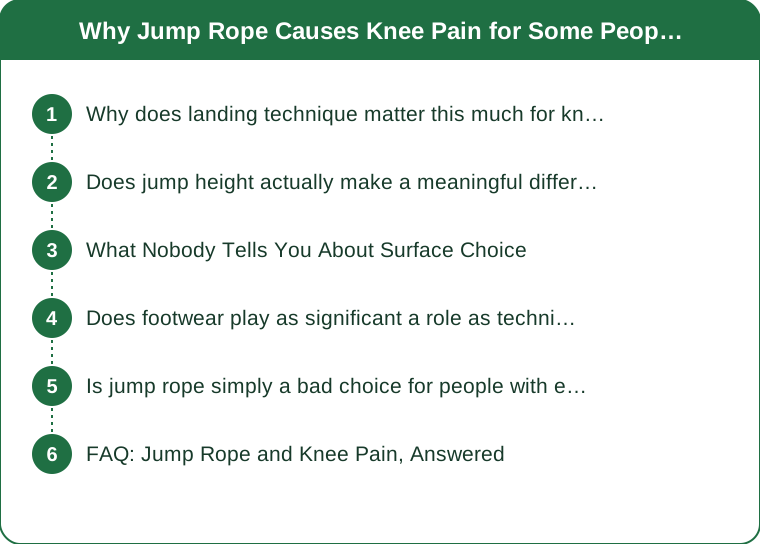
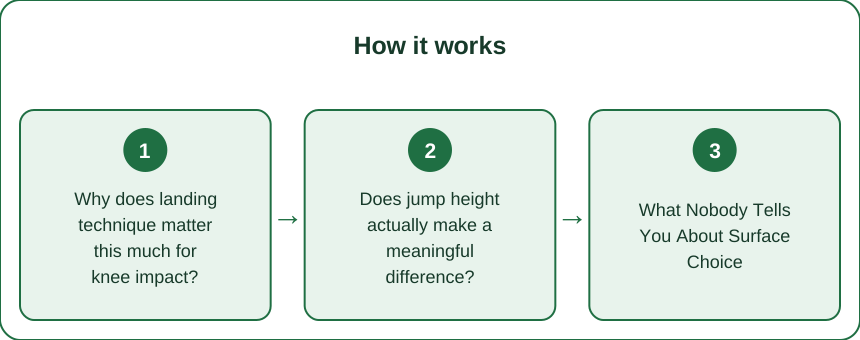
Why does landing technique matter this much for knee impact?
Landing flat-footed or with locked, straight knees sends impact force directly up through the knee joint with minimal natural shock absorption, while landing softly on the balls of the feet with slightly bent knees lets the calf and ankle absorb much of that impact before it reaches the knee at all.
Does jump height actually make a meaningful difference?
Yes — jumping higher than necessary (just enough to clear the rope) increases landing impact force with each rep, compounding over hundreds of jumps in a session. Minimizing jump height to just clear the rope reduces cumulative knee stress significantly.
What Nobody Tells You About Surface Choice
Jumping on concrete or hard tile transmits far more impact force to the knees than a sprung wood floor or a proper jump rope mat, and this surface difference alone can be the deciding factor between comfortable and painful sessions for people otherwise using decent technique.

Does footwear play as significant a role as technique?
Yes — shoes without adequate cushioning specifically in the forefoot (where jump rope landing impact concentrates) don’t provide the shock absorption jump rope needs, even with good landing technique — proper training or cross-training shoes matter more here than for many other workout types.
Is jump rope simply a bad choice for people with existing knee sensitivity?
Not necessarily — reducing jump height, using a well-cushioned surface, and building volume gradually rather than jumping into long sessions allows many people with mild knee sensitivity to jump rope comfortably, though those with more significant existing knee issues should get individualized guidance before starting.
FAQ: Jump Rope and Knee Pain, Answered
How much jump rope volume is reasonable when starting out?
Starting with short intervals (30-60 seconds) with rest between, rather than long continuous sessions, lets the body adapt to the impact gradually.
Does a heavier or lighter rope change the knee impact?
Rope weight affects arm and shoulder effort more than landing impact directly, so it’s a secondary factor compared to landing technique and surface for knee-specific pain.
Should knee pain during jump rope always mean stopping immediately?
Mild discomfort that improves with technique adjustment is common to troubleshoot, but sharp or worsening pain is a signal to stop that session and reassess rather than push through it.
TL;DR:
- Flat-footed or stiff-legged landing sends impact directly into the knee joint
- Minimizing jump height reduces cumulative landing force significantly
- Surface choice (hard floor versus cushioned) meaningfully changes impact transmission
- Proper cushioned footwear matters more for jump rope than many other workout types
Most jump rope knee pain is a fixable technique and equipment issue, not a sign the activity itself is a bad fit.
Keep Reading
This article is for general informational and styling purposes only. Fit, sizing, and product availability may vary.