Why Jumping Higher Is the Most Common Reason You Cannot Skip for Longer
Quick Answer: A jump rope needs roughly two to three centimetres of ground clearance to pass under your feet. Most beginners jump ten to fifteen centimetres, which multiplies the work done per rep by a large factor and loads the calves and Achilles far more than necessary. Cutting jump height is the single highest-return change in skipping — it typically doubles or triples the time you can sustain a set without any change in fitness at all.
This is not a fitness problem being solved by technique.
It is a technique problem that has been mistaken for a fitness problem.

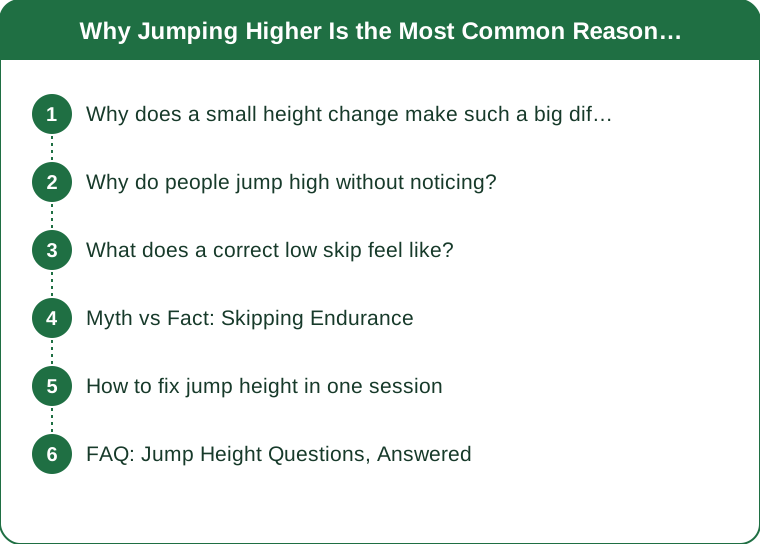
Why does a small height change make such a big difference?
Because the cost of a jump does not scale gently with height.
Every jump requires you to lift your body mass off the ground and then absorb it on landing. Raising the height increases both the work going up and the impact coming down. Landing forces in jumping are consistently measured at several times body weight, and they rise with drop height.
So a fifteen-centimetre jump is not modestly more expensive than a three-centimetre one. It is dramatically more expensive, in both energy cost and tissue loading — and you are paying it two to three times a second, for the whole set.
At roughly 120 to 140 skips a minute, that is 120 to 140 unnecessary lifts and landings per minute. No amount of conditioning makes that cheap.
The second cost is timing. Higher jumps mean longer airtime, and longer airtime means the rope has to travel slower to match, or you have to spin it faster than feels natural to catch the window. Either way the rhythm becomes harder to hold, which is why high jumpers trip more often as well as tiring sooner.
And the third is that height comes from the knees and hips, which are heavy joints doing an ankle’s job. Low skipping is essentially an ankle and calf action with a quiet knee. High skipping recruits the whole leg into a squat-jump pattern that is enormously more demanding.
Why do people jump high without noticing?
Four reasons, and most people have at least two of them.
The rope is too long. A rope that is too long has more slack, hits the ground further in front of you, and creates a bigger arc — which genuinely does require a higher jump to clear reliably. This is the most common mechanical cause and it is entirely fixable.
Fear of tripping. Extra height is insurance. Every trip reinforces the instinct to jump higher, so the habit is trained by the very failures it causes.
Transfer from other jumping. If your background involves box jumps, plyometrics or any sport with real jumping, the default jump you have trained is a big one. Skipping asks for something closer to a bounce.
Never having seen the target. Most people have simply never been told that two centimetres is the number. If your mental model is jumping, you will jump. If your mental model is a barely-leaving-the-floor bounce, you will bounce.
That last one is why the fix is often astonishingly fast. Told the actual target, a lot of people halve their jump height within a single session — this is not a strength adaptation, it is a change to an internal target that was never set correctly.
What does a correct low skip feel like?
Different enough that most people assume they are doing it wrong at first.
The contact is on the balls of your feet, with the heels never fully touching down but also never held high. A useful cue is that the heel should be hovering, not lifted — actively holding the heels up is a common overcorrection that fatigues the calves fast.
The knees stay soft and barely move. If your knees are visibly bending and extending on each rep, you are jumping rather than bouncing. The joint doing the work should be the ankle.
The elbows stay close to the ribs and the hands sit slightly forward of the hips. The rope is turned by the wrists, not the arms. Wide arms make a bigger arc, which forces a bigger jump, which is the same problem arriving from the other end.
The sound changes. A low skip is quiet — a light tap on each landing. A high skip lands with a thump. This is genuinely the easiest self-assessment available: if you can hear yourself landing from across a room, you are jumping too high.
It feels rushed at first. With less airtime, the rope comes round sooner, and the rhythm is quicker than most beginners expect. That quickness is correct. Slowing the rope to match a high jump is how people end up at a laboured pace that is somehow still exhausting.

Myth vs Fact: Skipping Endurance
Myth: If you can only skip for forty seconds, you need more cardio.
Fact: Most people who can only skip for forty seconds can run for twenty minutes. The limit is local — calves and technique — not cardiovascular. Fixing jump height usually adds more time than a month of conditioning.
Myth: Skipping is a calf exercise, so calf fatigue is expected.
Fact: It loads the calves, but efficiently performed skipping distributes work through the ankle complex and uses elastic recoil from the tendon rather than muscular effort on every rep. Calves burning out in under a minute is a sign of excessive height, not of correct technique.
Myth: Weighted ropes make you better at skipping.
Fact: They make the rope easier to feel, which helps some beginners with rhythm, and they load the shoulders. They do not fix jump height and can make a high jumper’s problems worse by slowing the rope further.
Myth: Softer surfaces are always kinder.
Fact: Very soft surfaces absorb the elastic return you want from each landing, which makes each rep more muscular and more tiring. A firm surface with a small amount of give — wood, a thin mat, smooth tarmac — outperforms thick foam.
Myth: You should aim to skip continuously for long periods.
Fact: Skipping is far better programmed in sets than in duration, and this is the correction that saves the most shins — thirty seconds on, thirty off, repeated, gives you far more quality reps and much less accumulated impact than one grinding three-minute effort ever will.
How to fix jump height in one session
Five drills, about twenty minutes, in order.
1. Size the rope first. Stand on the middle of the rope with one foot. The handles should reach roughly to your armpits — not to your shoulders, which is the more commonly quoted and generally too-long version. If in doubt, shorter. A short rope forces a low jump; a long one permits a high one.
2. Bounce without the rope. Sixty seconds of the smallest possible bounces on the balls of your feet, knees soft, heels hovering. This is the movement you are actually trying to perform. Feel how little effort it requires.
3. Add the rope, eyes closed for ten reps. Sounds odd, works well. Without visual feedback, most people default to a smaller, more efficient bounce because they stop trying to watch the rope clear.
4. Skip next to a wall or mirror sideways on, and look at how far the balls of your feet leave the floor. Almost everyone is shocked the first time. Aim to halve it.
5. Use sound as the metric. Do thirty seconds trying to be as quiet as possible. Quiet is a proxy for low and controlled, and it is a cue that works instantly because the feedback is immediate.
Then test: thirty seconds, rest thirty, repeat six times. Most people who make this change find their sustainable set length increases substantially within one or two sessions.
If you have current shin, knee or Achilles pain, address that before increasing volume — reducing jump height helps considerably, but it is not a treatment. This is general fitness information, not medical advice.
FAQ: Jump Height Questions, Answered
How high should I actually be jumping?
Enough to clear the rope and no more — practically, around two to three centimetres. If you can slide a couple of fingers under your foot at the top of the bounce, that is the right neighbourhood.
Won’t skipping this low be too easy to be a workout?
No, and this is the common worry. You will find the pace is quicker, the sets are longer, and the total work goes up rather than down. What decreases is the wasteful vertical component and the impact loading, not the training effect.
Should my heels touch the ground at all?
Briefly and lightly is fine, and it is easier on the Achilles than holding them permanently up. What you want to avoid is landing heavily on the heel or rigidly locking them high. Hovering, with an occasional light touch, is the sustainable version.
Does this change for double unders?
Double unders genuinely do require more height — enough for two passes — but far less than most people use. The same principle holds: minimum necessary clearance, and a faster wrist rather than a bigger jump. Most failed double unders are rope speed problems dressed up as height problems.
How do I know if my rope is too long?
If the rope is hitting the floor noticeably in front of your toes rather than just under them, or if you have to make wide arm circles to keep it moving, it is too long. Shortening a rope is the cheapest technique fix available and takes two minutes.
TL;DR:
- A rope needs about two to three centimetres of clearance; most people jump five times that
- Jump cost rises steeply with height, and you are paying it two to three times per second
- Higher jumps mean longer airtime, which makes the rhythm harder and causes more trips, not fewer
- A rope that is too long is the most common mechanical cause — size it to your armpits, not your shoulders
- Use sound as your metric: quiet landings mean low, controlled, sustainable skipping
Skip for thirty seconds trying to make no noise at all. If your set length jumps this week without your fitness changing, you have just found out what was actually limiting you.
Keep Reading
This article is for general informational and styling purposes only. Fit, sizing, and product availability may vary.