Why the Standard Way of Sizing a Jump Rope Is Wrong for Most People
Quick Answer: The armpit rule was written for heavy beaded and leather ropes turned slowly with the whole arm. Modern PVC and coated cable ropes are lighter and faster and are turned with the wrists, so they need to be considerably shorter - typically handles reaching somewhere between the lower ribs and the sternum, not the armpits. A rope that is too long is the single most common reason people conclude they are bad at skipping.
Here is how to size it properly and what each length actually does to your form.

What does a rope that is too long actually do?
It slows the rotation and forces you to jump higher. Extra rope length means a bigger arc and more time in the air needed to clear it. You end up jumping 15 centimetres when 5 would do, which is exhausting and hard on the calves.
It also makes you drop your hands. With too much slack, the instinctive fix is to lower the handles toward your hips to take up the extra, which wrecks the wrist mechanics and turns skipping into an arm exercise.
Rhythm becomes unpredictable. A long rope slaps the floor unevenly and the timing shifts between revolutions. What feels like poor coordination is often just an inconsistent arc.
Trips increase, and not where you expect. A long rope catches on the way up more than the way down - it hits your toes as you land rather than your heels. That signature is a useful diagnostic on its own.
And the fatigue lands in the wrong places. Too-long rope means shoulders and calves fatigue first. Correct length puts the work in the wrists and the feet, which is what you actually want.
So what length should it be?
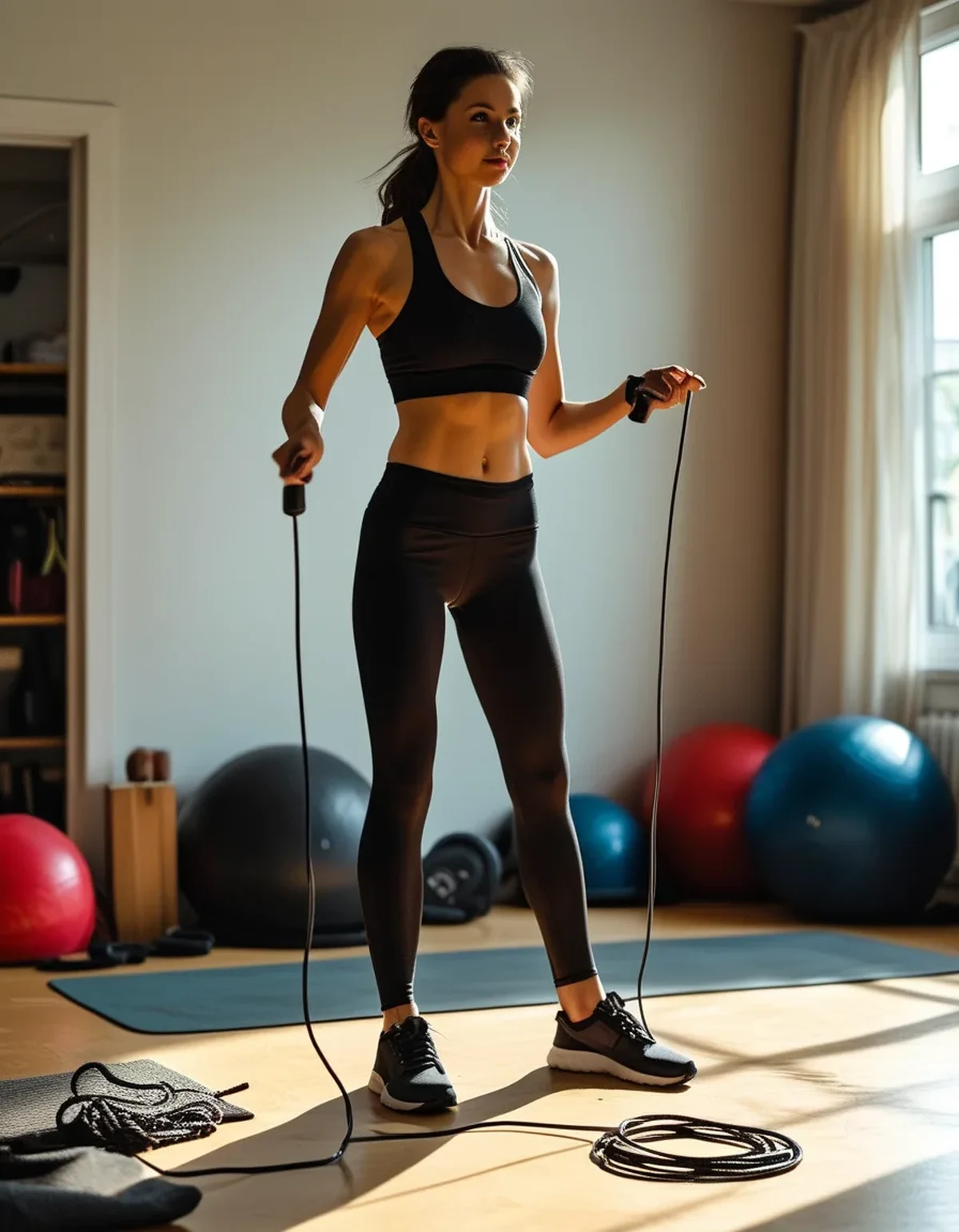
Start with the sternum, not the armpits. Stand on the centre of the rope with one foot, pull both handles straight up. For a general fitness rope, the handle tops should reach roughly the bottom of your sternum to the base of your ribcage.
By experience level, roughly: complete beginner, handles at the armpit or just below - the traditional rule is a fair starting point only if you have never skipped. After two weeks, shorten it. Regular skipper, handles at mid-chest. Fast or double-under work, handles at the lower ribs or lower.
Height gives a usable starting number too. Under 5’3”, a 8ft rope; 5’3” to 5’7”, 8’6”; 5’7” to 6’0”, 9ft; above that, 9’6”. These are starting points to adjust from, not answers.
The functional test beats every measurement. Jump ten times at your normal pace. The rope should pass under your feet with about 2 to 3 centimetres of clearance and make a light, consistent tick on the floor - not a loud slap.
Buy adjustable, always. Any rope where you can shorten the cable at the handle lets you find your own length over a few sessions. A fixed-length rope is a guess you cannot correct, and the right length changes as your technique improves.
Shorten in small increments. Two to three centimetres at a time, then jump 50 reps. Big adjustments overshoot and you lose the reference point of what the previous length felt like.
Does the surface and the shoes change it?
Yes, and people forget to re-check after switching either. A springy gym floor gives you more air time than concrete, so a rope that felt right indoors will feel long outdoors.
Shoe stack height changes your effective length directly. Moving from flat trainers to a cushioned running shoe with a thick sole adds 2 to 3 centimetres of height, which is exactly the increment you would adjust the rope by.
Skipping barefoot or in flat shoes makes the rope feel longer for the same reason, in reverse. If you train both ways, size for the shoe you use most and accept a slight compromise.
Outdoor surfaces wear PVC ropes fast. Concrete and tarmac abrade the cable, and a rope that frays will eventually change length as the coating goes. Use a coated cable outdoors and keep the PVC one for indoors.
Cold changes the rope itself. PVC stiffens noticeably below about 10°C and turns differently - which is why the rope that felt perfect in August feels wrong on a cold morning in October. It is the material, not you.
And ceiling height is a real constraint indoors. If you are catching the ceiling, you need a shorter rope and lower jumps, not a different exercise - most people can skip in a room with 2.4 metre ceilings once the rope is correct.
What Nobody Tells You About Rope Length
The right length changes as you improve, and nobody warns you. As your form tightens and your jumps get lower, the rope you sized in month one is too long by month three. Re-check every four to six weeks in the first six months.
Rope weight interacts with length. A heavier rope gives more feedback and is easier to learn on but wants to be slightly longer; a light speed rope wants to be shorter. Changing rope type means resizing.
Handle length counts as rope length. Long handles effectively lengthen the arc. When comparing two ropes, measure from the point where the cable exits the handle, not from the handle end - otherwise you are comparing different things.
Most people cut too little the first time. The instinct is to leave extra for safety. Extra length is the actual problem, and being slightly too short is a much better error - you simply jump a little lower.
Do not cut the cable until you have adjusted it. Coil the excess inside the handle for a couple of weeks first. Cutting is irreversible and the right length is not obvious until you have skipped at it.
And the arc is set by hand position, not just cable. Hands slightly forward of the hips and about 15 centimetres out from the body is the reference. If you have to lower your hands to make the rope clear, the rope is too long - the hands are telling you the answer.
How do I know when I have it right?
The sound tells you first. A correctly sized rope makes a light, even tick as it passes. A loud slap means too long; no sound at all usually means you are jumping too high to compensate for something.
Your jump height should be minimal. Two to five centimetres is plenty. If you are clearing 10 centimetres or more, either the rope is long or the habit has stuck from when it was.
Elbows stay close to the ribs and hands stay quiet. Big circular arm motion is a length problem in disguise. The wrists should be doing nearly all the turning.
Trip location is diagnostic. Catching the toes on landing points to too long. Catching the heels usually means hands too far forward rather than a length issue - that one is a technique fix.
You should manage 60 unbroken jumps. If you cannot string together a minute at a steady pace on a smooth surface, check length before assuming it is fitness. Most people find it is the rope.
And if your shins hurt, look at jump height first. Excessive height comes from excess rope, and the landing force is where shin pain comes from. Fix the length, lower the jump, and build volume gradually - 3 sets of 60 seconds with full rest is a reasonable starting point. Persistent shin pain that does not settle with reduced volume deserves a professional opinion. This is general information, not medical advice.
FAQ: Jump Rope Sizing Questions, Answered
Is the armpit rule completely wrong?
Not completely - it is a reasonable first-week starting point for an absolute beginner with a heavier rope. It is wrong as a permanent setting, and wrong from day one for a light speed rope.
How short is too short?
When you cannot clear the rope without noticeably tucking your feet, or it catches your heels consistently on a smooth surface. Slightly too short is a far better error than slightly too long.
Should I cut the excess cable off?
Not immediately. Coil it inside the handle for a few weeks and confirm the length first - cutting is irreversible and your ideal length shifts as your form improves.
Does rope weight matter for beginners?
Yes. A slightly heavier PVC rope gives more feedback about where the rope is in its arc, which makes the timing far easier to learn than a light speed cable.
Why does my rope feel different in cold weather?
PVC stiffens below roughly 10°C and turns with a different rhythm. It is a material property, not a change in your technique.
How often should I re-check my length?
Every four to six weeks for the first six months, and any time you change shoes, surface, or rope type. Each of those changes your effective length.
TL;DR:
- The armpit rule dates from heavy ropes turned with the arms. Modern light ropes need to be considerably shorter.
- Target the sternum to lower ribs with the handles pulled up while standing on the centre - shorter as you improve.
- Too long means higher jumps, dropped hands, uneven rhythm, and toe catches on landing. That combination is a rope problem, not a coordination problem.
- Buy adjustable and shorten 2 to 3cm at a time, jumping 50 reps between adjustments. Do not cut the cable early.
- Re-check after changing shoes, surface, or rope type - stack height alone shifts your effective length.
- Listen for a light even tick, aim for 2 to 5cm of jump height, and keep the elbows near the ribs.
If you cannot string together 60 unbroken jumps, check the length before you blame your fitness.
Keep Reading
This article is for general informational and styling purposes only. Fit, sizing, and product availability may vary.