Why Your Jump Rope Feels Completely Different on a Cold Morning
Quick Answer: PVC and plastic ropes stiffen substantially in cold air, which changes their rotation speed, how they whip, and how much they sting on a miss. Coated steel cables are far less affected but transmit more shock through cold hands. Concrete also hardens the impact and your muscles are less compliant, so shins take more load. Adjust by warming up longer, shortening your session, and switching to a cable or a heavier beaded rope in winter.
The first cold session of the year is always a surprise. Same rope, same technique, and suddenly the timing is off, the rope catches your feet, and a miss across the calf hurts far more than it did in August.
Materials change with temperature, and jump ropes are made of the material most affected by it.

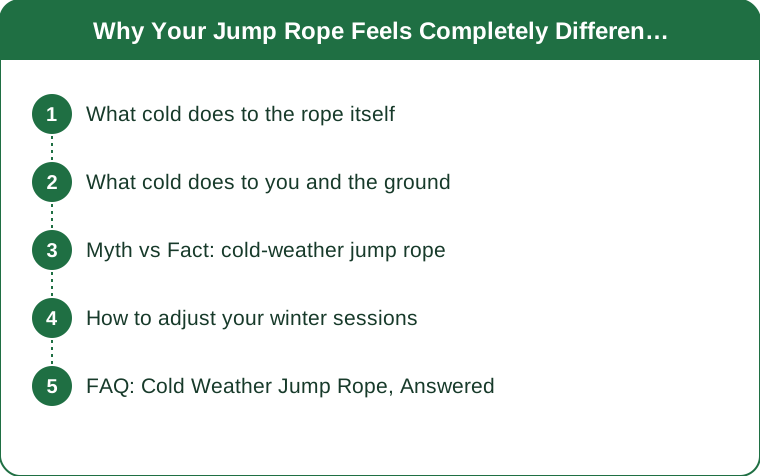
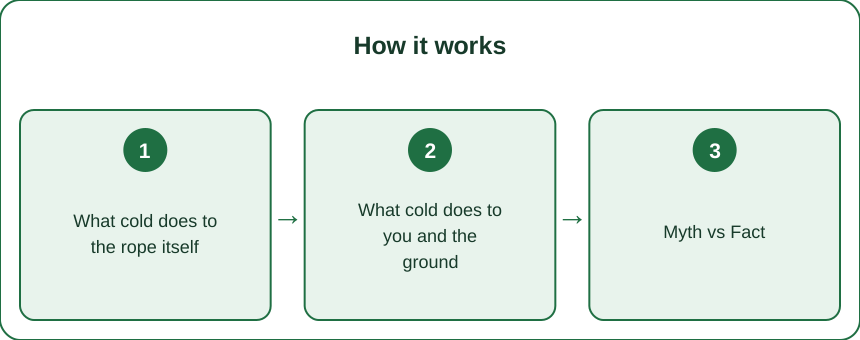
What cold does to the rope itself
It depends almost entirely on what your rope is made of.
PVC ropes stiffen the most. PVC is a thermoplastic, and below roughly 50°F it becomes noticeably more rigid. A stiffer rope holds its arc differently, rotates with less consistent speed, and does not conform the way you are used to. Below freezing, cheaper PVC can become brittle enough that a hard strike on concrete can crack it.
The whip changes. A cold, stiff rope transfers more energy on impact and less into deformation — which is exactly why a miss stings more. The rope is not moving faster; it is absorbing less.
Beaded ropes handle cold well. The segments are rigid at any temperature, so the behavior barely changes, and the added weight helps with feedback. This makes them one of the better winter options.
Coated steel cables are the most temperature-stable. The cable itself does not care. The coating stiffens slightly, but the change is small compared to PVC.
Handles and bearings matter too. Bearing grease thickens in cold, so a speed rope with sealed bearings can feel slightly draggy for the first minute until it warms up. This resolves quickly and is not worth worrying about.
What cold does to you and the ground
The rope is only part of it.
Muscles and tendons are less compliant when cold, which means the Achilles and calf complex absorb impact less effectively. That load transfers up to the shin, and cold-weather sessions are a well-known way to provoke shin discomfort in people who have never had it.
Concrete gets harder in the cold. This one is real but often overstated — the meaningful part is that cold pavement combined with cold-stiff footwear midsoles gives you a genuinely harder landing surface. EVA foam in running shoes stiffens noticeably in cold, so your shoes are providing less cushioning than they do indoors.
Grip changes. Cold hands grip harder, and a tighter grip means more forearm tension and less wrist articulation — which is the actual engine of an efficient jump rope stroke. Over-gripping is the most common cold-weather technique fault and it produces both slower rotation and faster arm fatigue.
Breathing is harder in cold dry air, so perceived effort rises at the same workload. Do not read this as a fitness problem in the first minute.
Together these explain the whole experience: the rope feels different, the landing feels harsher, your arms tire sooner, and the session feels harder than the numbers suggest.

Myth vs Fact: cold-weather jump rope
Myth: You should just jump faster to warm up. Fact: Starting at speed on cold tissue is how shin and Achilles problems begin. Warm up with something else first — brisk walking, easy jogging, or two minutes of low, slow bouncing without the rope.
Myth: A cold rope is more likely to break. Fact: Cheap PVC can crack in genuinely freezing conditions, but most quality ropes survive fine. The more common failure is fraying at the handle from repeated hard strikes on cold concrete, which is an abrasion issue rather than a cold one.
Myth: If the rope keeps catching my feet, my technique regressed. Fact: A stiffer rope rotates differently and your timing has to adjust by a fraction. Give it two or three minutes before concluding anything about your technique.
Myth: Cold-weather jumping burns more calories. Fact: Marginally, from thermoregulation, but the difference is small and is not a reason to train in the cold. Train in the cold because it is convenient and you enjoy it.
Myth: You need a completely different rope for winter. Fact: Not necessarily. Most people can adapt with a longer warm-up and slightly shorter sessions. A dedicated winter rope is a nice upgrade, not a requirement.
How to adjust your winter sessions
Concrete changes, in order of importance.
Warm up twice as long as you think. Five to ten minutes of general movement before the rope touches the ground. This is the single most protective thing you can do and the most commonly skipped.
Start with low, slow bounces for the first two minutes. Let the rope, the bearings, your hands, and your calves all come up to temperature together before you do anything at speed.
Shorten the session or break it into more intervals. Cold sessions accumulate impact load faster relative to how prepared your tissue is. Twelve minutes of intervals is a better winter session than twenty continuous.
Wear gloves thin enough to feel the handles. Cold hands over-grip. Thin liner gloves solve this without wrecking your wrist mechanics — thick gloves make it worse by forcing an even bigger grip.
Consider a beaded or cable rope for winter. Both are far more temperature-stable than PVC. A beaded rope also gives audible rhythm feedback, which helps when your timing is off.
Find a softer surface if you can. A gym mat, a wooden deck, or even a stall mat outdoors changes the impact meaningfully. Avoid jumping on frost or wet leaves for obvious reasons.
Store the rope indoors. A rope left in a cold garage or car starts every session at its stiffest. Bringing it inside costs nothing and removes half the problem.
FAQ: Cold Weather Jump Rope, Answered
At what temperature does this start to matter?
Most people notice PVC stiffening below about 50°F and it becomes obvious below 40°F. The tissue and surface effects are more gradual and depend heavily on how well you warm up.
Will jumping in the cold cause shin splints?
It raises the risk if you skip the warm-up or jump the same volume you do indoors. Cold, stiff calves and a harder landing surface are the mechanism. Warming up properly and reducing volume for the first few cold sessions handles most of it. This is general information, not medical advice.
Should I keep my rope in the car?
No. A rope stored in a cold car is at its stiffest and most brittle when you start, and heat cycling in summer is not great for PVC either. Store it inside.
TL;DR:
- PVC stiffens substantially below about 50°F, changing rotation, timing, and how much a miss stings; beaded and cable ropes barely change.
- Cold muscles absorb impact less well and cold shoe foam cushions less, so shins take more load.
- Cold hands over-grip, which kills wrist mechanics and tires your forearms faster.
- Warm up twice as long, start with slow low bounces, shorten sessions, wear thin gloves, and store the rope indoors.
If your first cold session felt like you had forgotten how to skip, you had not. The rope changed, the ground changed, and your calves were not ready — all three are fixable in about ten minutes of warm-up.
Keep Reading
This article is for general informational and styling purposes only. Fit, sizing, and product availability may vary.