Why Your Jump Rope Timing Falls Apart on a Hard, Cold Floor
Quick Answer: Hard surfaces change skipping because they return energy faster — you rebound sooner than you expect, which shortens your air time and makes the rope arrive late. Cold also stiffens PVC and wire ropes, changing their swing speed. Adjust by shortening the rope slightly, reducing jump height, and giving yourself two to three sessions to recalibrate rather than assuming your technique broke.
Outdoor skipping on a park path or a rubber mat all summer, and it felt effortless. Now you are on a garage floor or a kitchen tile in December and you are tripping every fifteen jumps.
Same rope, same body, same routine.
The surface underneath you is a bigger variable in skipping than in almost any other exercise, and here is why.

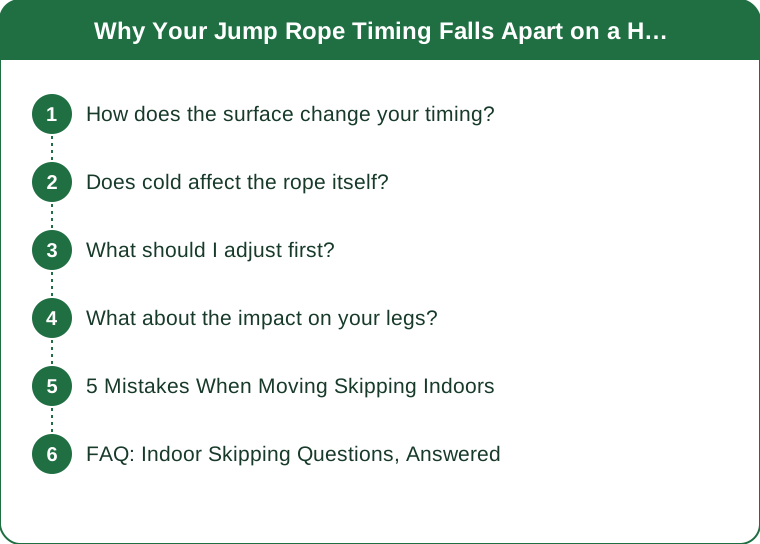
How does the surface change your timing?
Through energy return, which controls how long you stay in the air.
Skipping rhythm depends on your ground contact and flight time matching the rope’s rotation. Both are affected by how much energy the surface gives back.
A hard surface returns energy fast. You compress less, your Achilles and calf act as a stiffer spring, and you come off the ground quicker. Flight time changes by a small amount — but the rope is turning at a fixed rate, so a small change is enough to make it arrive at the wrong moment.
A soft surface absorbs energy. More compression, more ground contact time, a slower rhythm.
The result is that the same rope length and the same rope speed produce different timing on different floors. Your body adjusts automatically after enough repetitions, which is why the problem disappears after a few sessions and why it comes straight back if you switch again.
Does cold affect the rope itself?
Yes, and it is the part people never suspect.
PVC ropes stiffen considerably in the cold. A stiffer rope holds its arc differently, swings faster, and gives less feedback through the handles. A PVC rope that felt lively at 22°C can feel like a wire at 5°C in an unheated garage.
Coated wire ropes are less affected but not immune — the coating stiffens and the rope becomes less forgiving of a slightly wrong angle.
Beaded ropes are the most stable in cold because their timing comes from mass rather than material flex, which is one reason they are recommended for outdoor and cold-space training.
Practical response: let the rope warm up. A few minutes of easy turning, or simply keeping the rope indoors rather than in a cold garage, makes a noticeable difference to how it swings. Storing a PVC rope coiled in the cold also sets a memory into it that takes time to work out.
What should I adjust first?
Rope length, and by less than you would think.
On a hard surface your jumps get lower and quicker. A slightly shorter rope suits a lower jump, because there is less clearance needed and a shorter rope turns faster and more crisply.
Try 2 to 3cm shorter than your outdoor length as a starting point. The standard length check — stand on the middle, handles should reach roughly to your armpits — is a starting guide, not a rule, and experienced skippers usually run shorter than it suggests.
Then reduce the jump height deliberately. On a hard floor the correct jump is very small, roughly 2 to 3cm of clearance. Most timing problems indoors come from jumping as high as an outdoor rhythm allowed, which puts you in the air too long for the rope.
Change one variable at a time. Adjusting rope length and jump height and rope speed simultaneously means you learn nothing about which one mattered.

What about the impact on your legs?
It is real and it is the reason to be careful about the switch.
Hard surfaces transmit more force back through the foot, ankle, shin and knee. Skipping on concrete is a meaningfully higher-impact activity than skipping on rubber or grass, and the volume you built up outdoors does not transfer directly.
Shin pain is the common outcome — the classic story is someone moving indoors in October and developing shin splints in November, having changed nothing about their volume.
Practical protections: put a mat down. A rubber gym mat or even an exercise mat over concrete makes a substantial difference for very little money, and it also makes the timing closer to what you are used to.
Reduce volume by 25 to 30% for the first two weeks after a surface change, then build back. And wear shoes with real cushioning on hard floors — barefoot skipping on rubber outdoors is fine, barefoot on concrete is not.
5 Mistakes When Moving Skipping Indoors
Keeping the same session volume. The surface changed the load, so the volume should change too. Rebuild over two weeks rather than continuing from where you were.
Jumping too high out of habit. An outdoor rhythm allows a bigger jump; a hard floor does not need one and punishes it. 2 to 3cm of clearance is the target and it will feel absurdly small at first.
Blaming the rope and buying a new one. Almost always it is the surface and the temperature, not the equipment. Give it three sessions before spending money.
Skipping in a cold garage without warming up the rope or yourself. Cold PVC swings differently and cold calves are the ones that get injured. Five minutes of both.
Practising double unders during the adjustment period. Double unders demand precise flight time, which is the exact thing that has just changed. Get single-under rhythm back on the new surface first, then reintroduce them.
FAQ: Indoor Skipping Questions, Answered
How long does it take to adapt to a new surface?
Two to three sessions for the rhythm to feel natural again for most people, and the adaptation is largely automatic — you do not need to think about it, you need repetitions. What slows it down is changing several variables at once while you adapt.
Is a mat worth it, or should I just adapt to the floor?
Worth it, for the joints more than the timing. A rubber mat reduces impact and brings the energy return closer to what you are used to, so it solves the injury risk and part of the timing problem at once. It is the cheapest useful purchase in the sport.
Can I skip indoors without annoying the people below me?
Partly. A thick mat, low jumps, and a lighter rope all reduce transmitted noise, and jumping quietly is largely a matter of landing softly through the forefoot rather than flat. If you are above a neighbour, a heavy interlocking rubber mat rather than a thin exercise mat is the one that actually works.
TL;DR:
- Hard floors return energy faster, shortening your flight time so the rope arrives late — the surface changed your timing, not your technique.
- Cold stiffens PVC ropes noticeably. Store the rope indoors and let it warm up before judging it.
- Shorten the rope by 2 to 3cm and drop the jump height to 2 to 3cm of clearance. Change one variable at a time.
- Cut volume 25 to 30% for two weeks after a surface change and put a mat down — shin splints in November are almost always this.
Give it three sessions before you conclude anything. The adaptation is automatic if you stop changing things while it happens.
Keep Reading
This article is for general informational and styling purposes only. Fit, sizing, and product availability may vary.