Why Your Jump Rope Timing Falls Apart When You Move the Session Indoors
Quick Answer: Jump rope timing depends on how long you spend in contact with the ground, and that depends on the surface. A harder surface returns you upward faster, shortening your ground contact and speeding up the rhythm — which puts your rope timing out of sync. Moving from outdoor pavement to an indoor floor or mat changes contact time enough to break a rhythm you had established.
You jumped rope outside all summer and it felt automatic. First indoor session, and you are tripping on jumps you have not missed in months.

Why does the surface change the timing?
Because your rhythm is set by ground contact time, not by the rope.
A jump rope session is a repeating cycle: you leave the ground, the rope passes under, you land, you compress slightly, and you leave again. The compression phase is where the surface does its work.
A hard surface returns energy quickly and lets you leave the ground sooner. A soft surface absorbs energy, so you sink further and take longer to leave. The difference is on the order of tens of milliseconds per jump.
That sounds negligible until you consider that at 120 jumps a minute you are performing two per second, and your rope speed is set by your hands, which are running on the rhythm they learned on the old surface. A small mismatch between hand speed and jump timing compounds over a few jumps into a trip.
The rope itself contributes too. Rope speed and cable weight interact with the arc, and a heavier cable is more forgiving of timing errors while a light speed rope punishes them. If you also changed ropes when you moved indoors, that stacks.
Which direction does each surface push you?
Worth knowing because the correction is opposite in each case.
Concrete and hard indoor floors: shortest contact time, fastest rhythm. Highest impact on joints. If you moved from grass or an outdoor mat to a gym floor, your rhythm needs to speed up.
Rubber gym flooring and jump mats: moderate contact time. Usually the best compromise between joint comfort and consistent timing, which is why it is the most common recommendation.
Wooden sprung floors: longer contact time and a genuine spring, which some people find helps and others find unpredictable because the return varies with where you land relative to the joists.
Grass and soft ground: longest contact time, slowest rhythm, and the most variable — the surface itself differs from step to step, which makes rhythm harder to establish at all.
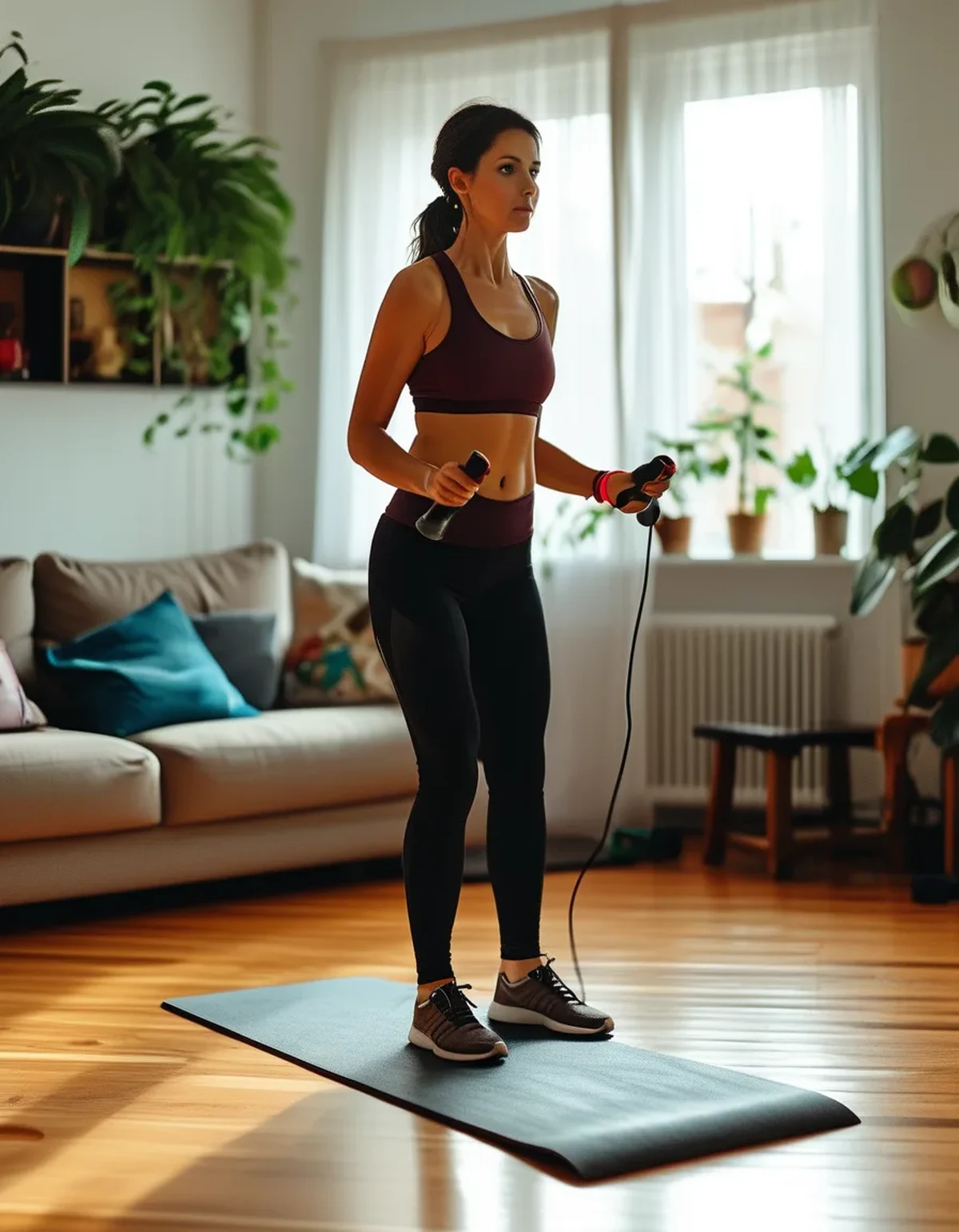
Thick foam mats: the trap. They feel joint-friendly and they absorb so much that timing becomes genuinely difficult, and the instability adds ankle work you may not want. A thin, dense mat is better than a thick soft one for rope work.
How do you adapt without spending a week tripping?
Rebuild the rhythm deliberately rather than trying to force the old one.
Start with slow single unders and no attempt at speed. Thirty seconds at a deliberately slow pace, focused on landing and leaving. You are letting your nervous system recalibrate the contact time.
Count out loud or use a metronome. External timing overrides an internalized rhythm that no longer fits. Start around 100 to 120 beats per minute and let your hands follow.
Do not attempt double unders for the first few sessions on a new surface. Double unders require precise timing and a higher jump, and both are exactly what has been disrupted.
Keep the same rope. Changing surface and rope simultaneously means you cannot tell which variable is causing what. Change one thing.
Expect three to five sessions. The recalibration is genuinely fast once you stop fighting it, and most people are back to normal within a week of consistent practice.
5 Mistakes That Make the Indoor Transition Worse
1. Jumping higher to compensate. When timing feels off, the instinct is to jump higher to buy time. Higher jumps mean more impact, faster fatigue, and a rhythm that is even harder to sustain. The correct jump is barely off the ground — an inch or two is enough for the rope to pass.
2. Speeding up the hands to catch the rope. The rope follows the hands, so speeding the hands up shortens the arc and makes the timing window tighter. Slow the hands down and the rhythm usually resolves itself.
3. Using a thick soft mat for joint protection. Understandable and counterproductive. A thin dense mat protects joints adequately and preserves the consistent return you need for rhythm. Thick foam absorbs too much and makes every jump slightly different.
4. Training in the wrong shoes. Indoor sessions often happen in whatever shoes are near the door. Rope work wants a shoe with some forefoot cushioning and a stable base — running shoes with a lot of heel and a soft midsole are less suitable than a flatter cross-training shoe.
5. Doing the same volume as outdoors from session one. Harder surfaces mean more impact per jump. Cut the volume for the first two sessions, particularly if you are moving from grass to a hard floor, because shin discomfort from a sudden surface change is the most common way this goes wrong.
What about ceiling height and space?
The other indoor variable, and it changes technique in ways people do not connect to the rhythm problem.
Low ceilings force a flatter rope arc, which means the rope travels a shorter path and arrives sooner. Combined with a harder surface also speeding things up, the rhythm change compounds.
If your ceiling is genuinely limiting, a shorter rope helps — rope length should have the handles reaching roughly to your armpits when you stand on the middle of the rope. A rope sized for outdoor use with plenty of clearance is often too long for a basement.
Confined space changes your jump. People jump more vertically and more tightly in a small room, which is actually good technique but feels restrictive and adds tension.
And the practical consideration for anyone in an apartment: impact noise travels. A dense rubber mat helps considerably, and jumping on a floor rather than over a joist span makes a noticeable difference to what the neighbors hear. Rope work is one of the highest-complaint home exercises, and sorting out the mat before the first session is easier than after a conversation.
One alternative worth knowing: a weighted rope with a shorter arc, jumped at a lower height, produces a comparable training effect with meaningfully less impact and noise. It is a reasonable substitute for anyone whose limiting factor is the building rather than the training.
FAQ: Indoor Jump Rope Questions, Answered
How thick should a jump rope mat be?
Thin and dense rather than thick and soft — something in the range of a quarter to half an inch of firm rubber is a common choice. That is enough to reduce joint impact and noise while preserving a consistent energy return. Thick foam mats feel better standing on them and make the timing harder.
Why do my shins hurt indoors when they never did outside?
Almost always a surface hardness change combined with unchanged volume. A harder surface means more impact per jump, and shin discomfort is the classic overload response. Cut the volume by about half for two sessions and build back up, and check that your shoes have adequate forefoot cushioning.
Should I change my rope for indoor use?
Not at the same time as changing surfaces, since you will not be able to tell what caused what. Once the surface adaptation has settled, a slightly shorter rope is often better indoors, particularly with a low ceiling. Change one variable and give it a few sessions.
TL;DR:
- Jump rope rhythm is set by ground contact time, which changes with surface hardness
- Harder indoor floors shorten contact and speed the rhythm, putting your hands out of sync
- Rebuild deliberately with slow single unders and a metronome, and skip double unders for a few sessions
- Use a thin dense mat rather than thick foam, and cut volume for the first two sessions on a harder surface
Your timing did not deteriorate. The surface changed how long you spend on the ground, and three to five sessions of deliberate recalibration puts the rhythm back exactly where it was.
Keep Reading
This article is for general informational and styling purposes only. Fit, sizing, and product availability may vary.