Why Your Shins Hurt From Jump Rope — and the Rope Itself Almost Never Is the Cause
Quick Answer: Shin pain from jump rope is almost always caused by landing technique — jumping too high and landing flat-footed or heel-first — not the weight or type of rope. Fix the bounce height and foot strike before assuming you need different equipment.
You’ve tried a lighter rope, then a slightly heavier one, hoping one of them would stop the shin ache that shows up after every session. Neither helped, because the rope was never really the variable causing it.

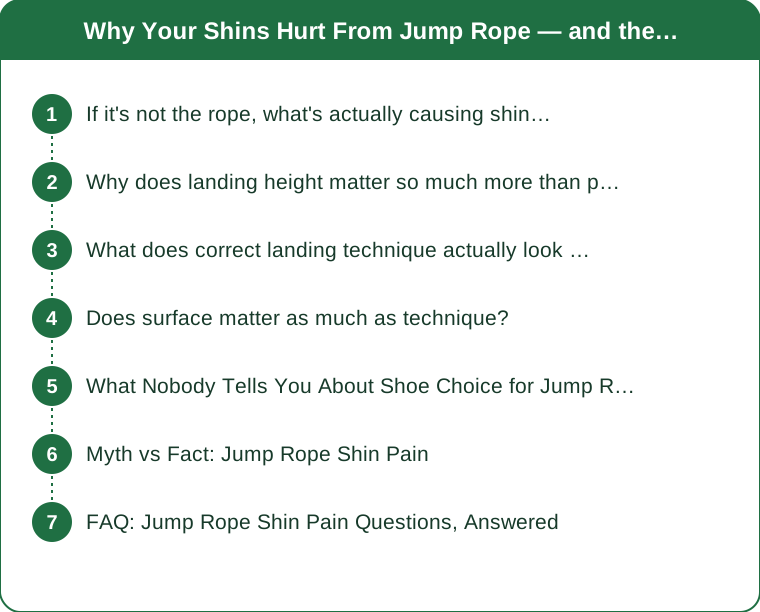
If it’s not the rope, what’s actually causing shin splint-type pain?
Landing mechanics. Jump rope shin pain overwhelmingly comes from jumping too high off the ground (more impact force to absorb on landing) and landing flat-footed or heel-first instead of softly on the balls of the feet. Each jump only needs to clear the rope by an inch or two — most beginners jump 4-6 inches or more out of habit, multiplying impact force with every single rep across a session that might include hundreds of jumps.
Why does landing height matter so much more than people expect?
Impact force scales with landing height in a way that compounds fast — jumping even a couple inches higher than necessary meaningfully increases the force your shins absorb on each landing, and jump rope sessions involve so many repetitions that a small per-jump difference adds up to a large total load difference over a session. Reducing jump height by even an inch or two, sustained over hundreds of reps, meaningfully reduces cumulative shin loading.
What does correct landing technique actually look like?
Land on the balls of your feet, with your heels staying just off the ground or barely tapping down, and keep jumps low — just enough clearance for the rope to pass under your feet, not the exaggerated bounce many people default to when learning. Slightly bent knees throughout absorb additional shock the joint itself doesn’t need to take on.

Does surface matter as much as technique?
Yes, as a secondary factor — jumping on concrete or asphalt transmits more impact than a proper gym floor or a rubber mat, since those harder surfaces don’t absorb any shock themselves. If you’re jumping on a hard surface and can’t move to a softer one, technique correction becomes even more important to compensate.
What Nobody Tells You About Shoe Choice for Jump Rope
Here’s an overlooked detail: worn-out cushioning in shoes you’ve used for other activities can quietly contribute to jump rope shin pain, even if the shoes look fine. Running shoes with compressed, aged midsole foam lose much of their shock absorption well before they look visibly worn out, and using them for a high-repetition, high-impact activity like jump rope can matter more than people assume.
Myth vs Fact: Jump Rope Shin Pain
Myth: A lighter rope reduces shin impact. Fact: Rope weight affects arm and shoulder fatigue, not landing force on your shins — that’s determined by jump height and foot strike.
Myth: Shin pain from jump rope means you should stop the activity entirely. Fact: For most people it means a technique correction (lower jumps, forefoot landing), not permanent avoidance.
Myth: More jump rope sessions will build tolerance to the pain. Fact: Continuing to jump with the same flawed landing technique usually worsens shin splints rather than building tolerance to them.
FAQ: Jump Rope Shin Pain Questions, Answered
How low should my jumps actually be?
Just enough clearance for the rope to pass — often described as barely leaving the ground, an inch or less, rather than an exaggerated hop.
Should I switch to a softer surface if shin pain persists?
Yes, if available — a rubber mat or gym floor meaningfully reduces impact compared to concrete, complementing (not replacing) technique correction.
How long before technique changes reduce shin pain?
Many people notice a difference within 1-2 weeks of consistently lowering jump height and landing on the balls of their feet.
TL;DR:
- Shin pain from jump rope is almost always a landing technique issue, not a rope issue
- Lower your jump height to just clear the rope — even a couple inches matters over hundreds of reps
- Land on the balls of your feet, knees slightly bent, not flat-footed or heel-first
- Surface and worn-out shoe cushioning are secondary factors worth checking too
Your next session, focus entirely on jumping lower and landing softer on the balls of your feet — skip worrying about the rope itself.
Keep Reading
This article is for general informational and styling purposes only. Fit, sizing, and product availability may vary.