Jump Rope Workouts for Women: 10 Minutes That Replace 30
Quick Answer: The best jump rope workout for beginners is intervals, not continuous jumping: 30 seconds jumping, 30 seconds walking rest, 10 rounds — ten minutes total. Size the rope so the handles reach your armpits when you stand on the middle, jump about an inch high, and turn from your wrists. Three sessions a week for a month changes your calves, coordination and cardio faster than almost any program of equal time.
The last time you touched a jump rope, you were ten and it was recess. Nothing about the rope has changed. Everything about what we know has.
Minute for minute, skipping burns roughly 10–14 calories — jogging territory and past it — while training rhythm, ankles, calves, shoulders and core at once. And the equipment costs less than lunch.


Why is jump rope such good cardio for women?
Three reasons stack up, and the third is the one that rarely gets mentioned.
Efficiency. At 10–14 calories a minute, ten focused minutes genuinely rivals a half-hour jog for cardiovascular work — and it takes zero travel time.
Bone density. Skipping is a weight-bearing, impact activity, which is exactly the kind of loading that supports bone health. That matters increasingly for women through our 30s, 40s and beyond, and it’s a benefit cycling and swimming simply don’t offer.
Portability. A rope weighs about 150 grams. It works in a driveway, a garage, a park, a hotel parking lot — which means the “I’m traveling” excuse and the “the gym was closed” excuse both quietly disappear.
What rope should a beginner buy, and how do you size it?
Buy an adjustable speed rope with ball bearings, roughly $12. The dollar-store rope with a permanent kink in it is the single biggest reason adults decide they “can’t skip” — it doesn’t spin evenly, so no technique saves it.
Sizing: stand on the middle of the rope with one foot. The handles should reach your armpits. Shorter than that and you’ll clip your feet constantly; much longer and the rhythm goes sloppy.
Rope type: beaded ropes turn a little slower and give you audible feedback, which makes them excellent for learning rhythm. Thin speed ropes are faster and less forgiving — save them for later.
Surface and shoes: jump on rubber tile, a wood deck or packed dirt, and wear supportive sneakers with cushioning, not flat fashion trainers. Concrete plus flat shoes is a recipe for shin complaints in week one.
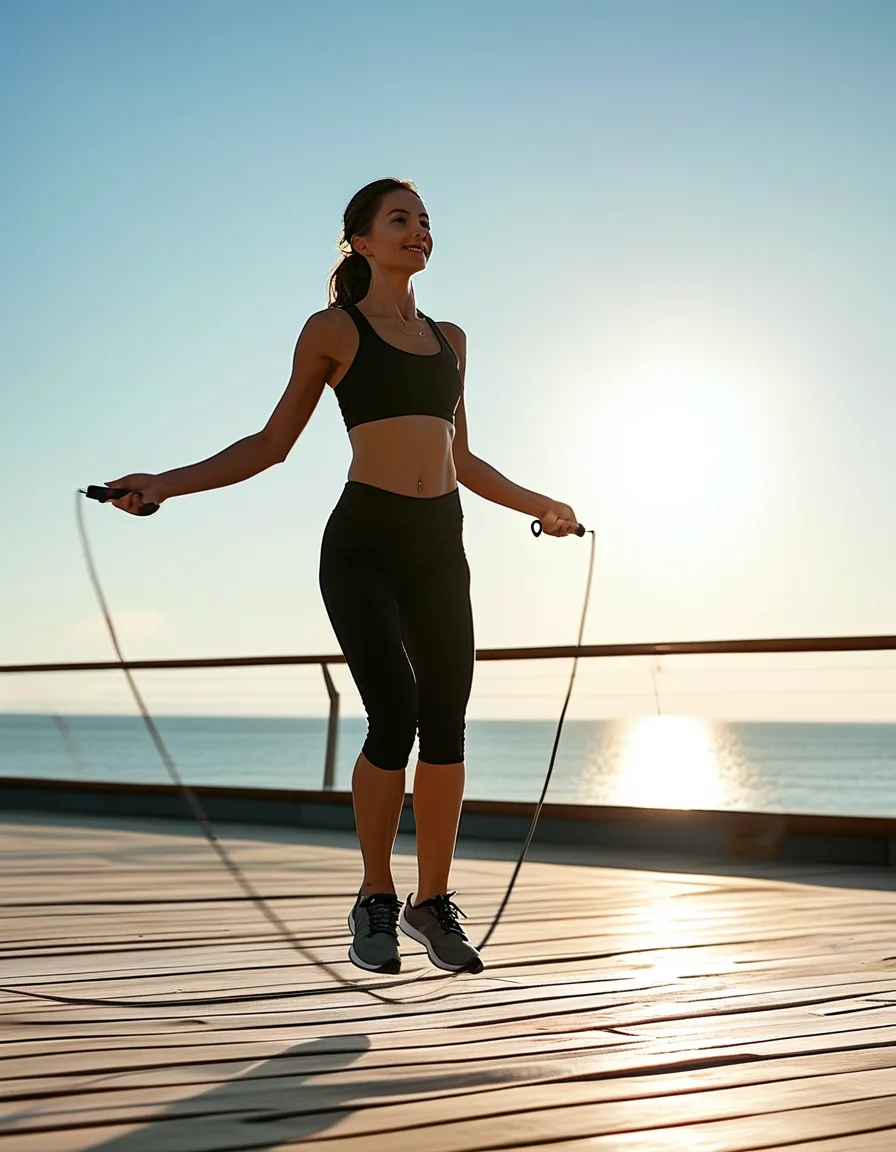
What’s the correct jump rope technique?
Almost everything wrong with adult skipping comes from trying too hard.
- One inch of air, not six. Jump just enough for the rope to whisper under your feet.
- Elbows pinned near your ribs. The spin comes from your wrists. If your arms are windmilling, you’ll last 90 seconds.
- Land soft on the balls of your feet, knees gently bent — never on flat heels.
- Eyes forward, not down. Watching your feet tips your weight and makes tangles more likely.
Practice the bounce without the rope first — 30 seconds of the exact hop you’ll use. Then add the rope. Expect tangles for about three sessions and expect it to click by session five. That timeline is remarkably consistent.

The 10-minute beginner workout
Interval style, because nobody skips continuously at first:
30 seconds jumping / 30 seconds walking rest × 10 rounds.
That’s the whole session. Ten minutes, heart thoroughly convinced, done before a podcast episode gets going.
How to progress it over 6 weeks:
| Weeks | Work / Rest | Rounds |
|---|---|---|
| 1–2 | 30s / 30s | 10 |
| 3–4 | 40s / 20s | 10 |
| 5–6 | 60s / 30s | 8–10 |
Once 40/20 feels manageable, learn the boxer step — shifting your weight foot to foot instead of two-foot hopping. It cuts the perceived effort noticeably and doubles the style points.
Three sessions a week, non-consecutive. That’s the program.
What Nobody Tells You About Starting to Skip
- Your calves will lodge a formal protest on day two. This is normal and passes within about two weeks as your tendons adapt. Stretch, take the rest day, continue.
- The rope will hit your toes roughly eleven times in session one. Also normal. It stops.
- A sports bra matters more here than in most workouts. Get the fit right before you decide skipping isn’t for you.
- Pelvic floor is a real consideration, especially postpartum. If you leak or feel heaviness, start with the no-rope bounce or the low-impact boxer shuffle and build up — and see a pelvic health physio if it persists.
- Progress is unusually visible. Going from 20 unbroken jumps to 100 in three weeks is common, and that feedback loop is exactly why the habit sticks.
If you have knee or ankle issues, existing joint pain, or you’re returning from injury or pregnancy, check with a professional before adding impact work.
Mini FAQ
How long should a beginner jump rope for?
Ten minutes of interval work is a complete session. Total jumping time in that is only about 5 minutes — which is the point. Chasing continuous jumping too early is the most common way beginners burn out.
Is jump rope good for weight loss?
It’s a strong tool because of calorie burn per minute and how little time it demands, but the results come from consistency and overall diet, not the rope itself. Three 10-minute sessions a week is a very realistic habit — and a realistic habit beats an ambitious one you quit.
Can I jump rope in an apartment?
Often yes, on a mat and with a low, soft bounce — but be honest about downstairs neighbors and ceiling height. If you’re short on either, the no-rope bounce and boxer shuffle give you most of the workout with none of the thud.
TL;DR:
- Buy a $12 adjustable speed rope; handles should reach your armpits.
- Jump 1 inch, wrists turning, elbows in, land soft.
- Beginner workout: 30s on / 30s off × 10 = 10 minutes.
- Progress to 40/20, then 60/30; add the boxer step.
- 3 sessions a week on a forgiving surface in supportive shoes.
- Sore calves for two weeks are normal; sharp joint pain is not.
A rope, a patch of ground and ten minutes — that’s the entire program.
Keep Reading
This article is for general informational and styling purposes only. Fit, sizing, and product availability may vary.